
The Delimitation Bills Raise Important Legal Questions
Ten Flaws that Warrant Caution

If you do not read the article but want a summary, it is thus: During delimitation, the polity is a milking buffalo everyone wants to tie in their backyard. History tells us that in matters of Delimitation, we must trust no one but God, we must revise the constitution of the commission, the process and its rules until they guarantee fairness. I demonstrate some issues with the draft bills circulated. (Linked here)
Summary
The Proposed Constitutional Amendment Act empowers the parliament to decide which census will form the basis of delimitation through an ordinary law which can be passed with a simple majority. The constitutional stipulation to delimit after every census is done away with, and delimitation will now happen at the mercy and will of the Parliament and the Central Government.
The Delimitation bill proposes the ‘the latest census when the commission is notified’ ad the census to be used. However, this stipulation can be changed by a simple majority in the future. The power under this delimitation bill continues beyond the present proposed exercise of delimitation.
The power to notify the commission, including the power to decide when to notify the commission and effectively which census applies to each state, lies with the Central Government. This power to decide which census applies must be constitutionally entrenched rather than being subject to the whims of the Central Government.
The actual total number of seats in the expanded Lok Sabha is not defined in the proposed amendment or the bill, and may be left to be decided by the Delimitation Commission. The proposed amendment only changes the upper limit on seats to 850 from the existing 550.
The principle of proportionality to population, as in the latest census, continues. There is no concession made to the southern states of a pro-rata increase where their seats increase in proportion of their existing seats, etc.. No promises made to Southern States stand incorporated in the bills.
The term duration of the Delimitation Commission must be fixed to avoid surprise decisions right before elections and to improve predictability. It was fixed under the previous act, and there are no pressing reasons for the change under the new bill.
Unless an independent appointment of the Chief Election Commissioner is secured, this process promises to be a charade because of the extensive administrative involvement of the Election Commission and a vote by majority. The opposition must also have an independent say in the constitution of the delimitation commission itself.
No methodological basis for the rotation of seats for women is laid down in the proposed amendment or the act. It is unclear when and how such a rotation will be done in the proposed amendment or in the bill.
The size as well as the composition of the Rajya Sabha is untouched, creating a structural tension. The upper house and effectively the states lose their relative strength, with important consequences for instance, in joint sittings.
The NDA does not have the required numbers to pass the proposed amendment unless it is supported by some non-alliance parties, especially from the North, on this issue.
In what follows, I will give article-by-article comments on the proposed amendment bill and the delimitation bill.
The Constitutional Amendment Act
I. Amendment to Article 55
Article 55 pertains to the Election of the President. The article in its original form mandates a uniform scale of representation in terms of its population across states as far as possible. The explanation in this article had a proviso that the relevant census would be the first census after 2026. That has now been done away with. The Parliament may, by law, ascertain which census is the relevant census (the latest census before the delimitation notification, as per the Delimitation Bill) for determining the population for the election of the president. This can be a cause of confusion if some, but not all, states have had delimitation simultaneously notified qua them.
II. Amendment to Articles 81 and 82
In the amended Article 81(1), the cap on the total strength of the House of the People elected from States is increased to 815 members. The cap on the strength of Union Territories is increased to 35, with the caveat that the actual number of seats is not specified for the strength of the House of People elected from states and Union Territories.
We must be circumspect that the proposed delimitation amendment and the delimitation bill do not specify the actual number of seats. It must also be noted that the final power to determine the strength of the Lok Sabha may vest in the Delimitation Commission or the parliament. The actual strength has not been defined in the amendment or the bill proposed; only a cap has been proposed.
As per Art. 81(2), which has been continued as the original, the principle of representation in proportion to population continues to be the sole governing principle, subject, of course, to reservations for SC, ST and Women.
Pro-rated increase as per the existing proportion, as is promised by the BJP leadership, is impossible unless Art. 81(2) is amended and the proposed Delimitation Bill reflects that the distribution will not be according to the latest available census but according to a pro-rated proportionate increase. The government may seek to interpret “so far as may be practicable” in Art. 81(2) to accommodate the demand; however, it is an unreasonable interpretation and it is a stretch to suggest that actually following the proportions is not practicable. A clear amendment may be a more desirable course. The government may be unwilling to touch Art. 81(2) for any changes to it expose the process to a basic structure judicial review for violating federalism and voter-equality. Art. 81(2) is therefore a tight-rope walk for the government. In any case, the Delimitation bill must be amended if the BJP government intends to act on this promise.
However, this was the most important change desired by the South Indian States—Tamil Nadu, Kerala, Andhra Pradesh, Karnataka and Telangana— which has not been granted even in any limited measure. If the 2011 or the 2026 census applies, southern states stand to lose a lot of seats to the north. See the charts below for a ballpark estimate:
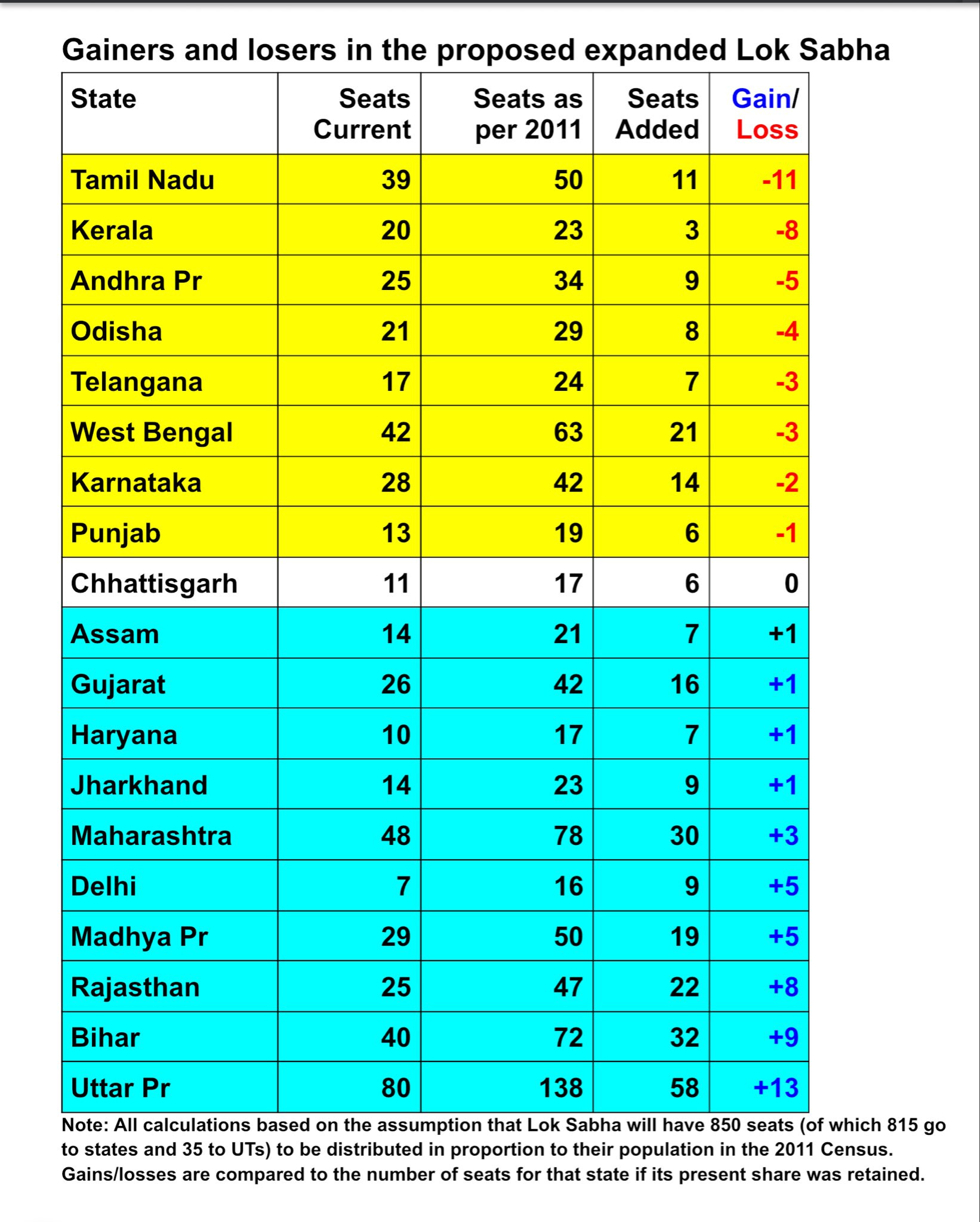
Source: Yogendra Yadav on X
Finally, in 3(b) of Art. 81; there existed a proviso for locking the first census after 2026 for delimitation. Further, this clause had a default that ‘population’ was to be determined as per the latest census whose figures have been published. These have been removed.
III. Amendment to Art. 82
As per the proposed amendment to A. 82, the delimitation of constituencies is no longer constitutionally mandatory after each census. When a delimitation is due shall depend effectively on the wisdom of the Central Government as to when it is necessary to constitute a Delimitation Commission. Yet again, the parliament may proscribe the discretion available to a delimitation commission as to which census is relevant or what is the “manner” of delimiting; subject to the principle of proportionality to population, as in Art. 81(2). The third proviso locking the population for the number of seats to 1976 and apportionment to 2001 is deleted.
The parliament has expanded its discretion to ascertain which census is to be used for determining the relevant population through ordinary law instead of an amendment requiring a special majority. For instance, in 2045, even when the 2041 census figures are published, the Parliament may, by law, choose to deem that the 2026 census is the relevant census by making a law through a simple majority.
This choice of which census is relevant is too sensitive to be left to the whims of the Central Government, either through a simple majority or by choosing the date on which the delimitation commission is notified, now or at any time in the future. It must be constitutionally entrenched.
Even if the Central Government wants to control precisely when delimitation happens, such control can be exercised while the principle of the latest census remains constitutionally entrenched.
IV. Amendment to Article 170
The delimitation of state assemblies is no longer subject to reservation for the Anglo-Indian Community as in Art. 333. This is not a very relevant change. The range of the number of seats in the legislative assemblies continues to be between 60 and 500 and has not been changed. The UP legislative assembly might need an expansion if we are to maintain the ratio of number of MPs to number of MLAs roughly constant across major states. This has not been considered. We might want to reconsider the upper limit of 500 MLAs only for UP to ensure a more effective representation ratio for Uttar Pradesh legislative assembly.
In the explanation to 2(b), a stipulation for a relevant population and census similar to the Lok Sabha is stipulated. Here too, the mandate to delimit after every census is done away with, and the stipulations about locking in till after the first census after 2026, using the 1971 census to determine total seats and the 2001 census to decide apportionment, are done away with.
V. Amendment to Article 330, 334A
Here too, the parliament is empowered by law to determine which census is relevant for reservations of seats for the Scheduled Castes and the Scheduled Tribes. The ‘First Census after 2026’ stipulation is removed for women’s reservation, too. For women’s reservations, the fifteen-year sunset clause, subject to extension by the parliament,t continues.
The Political Bundling of women’s reservation and delimitation is deliberate. This is sinister and aimed at conflating the two issues, making it difficult to criticise one without appearing to criticise the other. The original stipulation that the first census after 2026 will be the relevant census has now been done away with, without ever having been employed. It gives the impression that such a stipulation was added as a smokescreen to eventually merge the issue with that of delimitation and mislead the people. This political chicanery is grossly unsuited to important constitutional questions that require deliberative consensus.
Delimitation Bill
S. 1(2) Power to Notify, S. 3 Constitution of the Commission, S 7(4)
This Bill (after becoming an Act if it does) comes into force only when the Central Government chooses to notify it. Latest Census Figures, as per this act, mean the latest census figures available on the date of the constitution of the Delimitation Commission. The Central Government, under this Act, has the power to appoint a Delimitation Commission from time to time through a notification. This is a continuing power exercisable under the Act at the sweet will of the Central Government. The Central Government may also choose the date of appointment of the Delimitation Commissions in the future as it deems fit.
It must be noted that the parliament may, by a simple majority, amend this law to prescribe any other census year that they think the Delimitation Commission must use. Earlier, this provision was a constitutionally entrenched provision that the proposed amendment seeks to do away with. When the Central Government notifies a Delimitation Commission, whatever the latest census figures available are the only ones that must relevant to the exercise. However, that has now been moved from the constitution to a simple legislation giving the Central Government a lot more discretion on the issue. This must be read in light of our discussion on amended articles 81 and 82.
While this is a stretch, we must also consider that the Delimitation Commission (say in 2045) could be notified state by state (because the SEC is a member of the commission for that state only) on different states. It may be lawfully possible to set up a commission for different states on different dates, thereby making them liable to different censuses. This is crucial because judicial review of delimitation is limited to mala fides and ex facie arbitrariness only. The delimitation commission must be notified for all states together, and subject to a single cut-off date. Because this legislation will continue to be the law on this subject matter, an express stipulation to that effect may be useful even if it is trite.
Members of the Commission
The Commission is chaired by a Supreme Court judge chosen by the Central Government. The Chief Election Commissioner or his appointee and the State Election Commissioner are ex-officio members. The decisions of the commission are made by these three people on the basis of a majority vote. (S. 7(4)) We must be extremely circumspect about the immense power reposed in these. The statutorily fixed term duration of the Delimitation Commission has been altered to grant discretion to the Central Government. It must, however, also be specified expressly, as it was in the earlier statute, to avoid the process from becoming a never-ending exercise or to avoid strategic timing of commission notifications close to the announcement of state elections.
Independent Appointment of CEC necessary
The Chief Election Commissioner is appointed by a panel composing a majority held by the Central Government as per the Chief Election Commissioner and Other Election Commissioners (Appointment, Conditions of Service and Term of Office) Act, 2023. This Act was enacted in the face of the 5J decision in Anoop Baranwal. Unless the appointment of the Chief Election Commissioner is made by a neutral panel, the delimitation commission faces a strong constitutional challenge. The challenge to the 2023 Act is pending in Jaya Thakur v Union of India. It raises serious apprehensions of bias in the party ruling in the Central Government.
A Delimitation Commission must not be allowed to be appointed ex parte by the Central Government at this time in history, where trust in the Central Government and the BJP is at a historic low country-wide. The State Election Commissioner is a career bureaucrat appointed by the Governor on the advice of the government then in power in that state. Their impartiality, too, cannot be guaranteed. Then, the CEC and SEC might have an effective majority, irrespective of the opinion of the Supreme Court judge or the advisory opinions of the associate members. S.7(4) empowers the commission to decide by Majority.
Further, the conduct of Mr Gyanesh Kumar has raised serious doubts both about his impartiality and the impartiality of the appointment process that led to his appointment. Just because historically this has been the nature of the delimitation commission, we need not accept it. We operate in times of historically low trust. The delimitation in Jammu and Kashmir that created a lopsided majority in Jammu too, has raised doubts about gerrymandering. Likewise, the delimitation in Assam has been rightly questioned. All Political Parties must take serious note of this possibility of rampant gerrymandering.
Appointment of the Delimitation Commission, as well as the Chief Election Commissioner, must be done by an independent body with representation for the opposition parties and the Supreme Court in the appointment itself and not unilaterally by the Central Government. Without these changes, any attempted delimitation is a farce that raises serious doubts as to impartiality. Without changes to the appointment procedure of CEC and Election Commissioners and a role for the opposition in the appointment of the Delimitation Commission, this exercise must not be allowed to go through. The Secretary to the Delimitation Commission shall be one of the Secretaries to the Election Commission of India. The extensive role and involvement of the Chief Election Commissioner cannot be overstated. Therefore, the appointment of an independent election commissioner is a precondition to any serious exercise of delimitation.
A constitutional challenge to the Delimitation bill, if it becomes an act, could be sustained only on the issue of the appointment of CEC and the selection of members by the Central Government in such an important exercise as delimitation. It is an affront to the separation of powers.
S 5 Associate Members
Associate Members of the Commission are to be appointed as per the composition of the House of the State Assembly and representatives from that state to the Lok Sabha. These members cannot sign or approve any order of the commission, and their role is merely advisory. They can at best raise their contentions in dissent notes. The power to appoint these members is with the Speaker of the respective House. The principles for the selection of these members must be encoded in the statute. They cannot be left to the whims of the speakers, given their increasingly partisan record in the recent past.
The Delimitation Commission can make decisions even in the absence of a member or when the seat is vacant. This provision must go. Unless all three members of the Commission are alive and active, the Commission must not be allowed to make orders on Delimitation. While S. 6 mandates the Central Government or the Speaker to appoint alternate persons as soon as may be, it is wise to statutorily block the commission from operating when there is an unfilled vacancy.
S 4 Duties of the Commission
The Commission is tasked with deciding a) the allocation of seats in the House of the People (Lok Sabha) for States and Union territories, b) the total number of seats in the Legislative Assembly of each State and c) the division of each State and Union territory into territorial constituencies. The total number of seats is here presumed to be predetermined. We may presume that the upper limit given in the proposed amendment is the actual number of seats.
However, this must be clarified. Does “allocation” in S. 4 refer only to apportionment or the total number of seats in the House of People as well? Effectively, are the 850 seats the actual number of seats or merely the upper limit?
S. 8(C) second proviso, S. 9(e) Seats Reserved by Rotation
The Seats for Women are to be reserved by rotation as per S. 8(2)( c) second proviso. However, the act does not stipulate how the initial lot of seats is to be reserved for women. Would rotation mean that the first allocation is made randomly? Will it be rotation according to random selection without replacement? Or is the commission expected to apply specific criteria for determining the seats? For instance, is it important that women are selected from urban as well as rural seats within and across states? Then would a stratification be made before randomly choosing seats? This should be spelt out clearly in the Act itself. The same should also be clarified for seats reserved for SC and ST women.
Is this to be according to the election cycle, by dissolution, or only by delimitation? This needs express constitutional specification. The actual total number of seats, as well as apportionment for women, has been left to the delimitation commission and has not been circumscribed in this act. The limited guidance comes from the overall cap in the Constitution itself. It would be useful for the Central Government to clarify this.
Further, the act requires that the MP: MLA ratio, as far as possible, be an integer so that, as far as possible, the parliamentary constituencies have an equal number of legislative assembly seats.
The bills consciously skip amending the number of seats in the Rajya Sabha. This creates a gross imbalance between the Lok Sabha and the Rajya Sabha. This allows ordinary bills to be steamrolled in joint sittings of the parliament, as in Art. 108.
While some of the concerns in this article can benefit from clarification by the Central Government, the promises, if any, must be hard-coded into the legislation and the amendment itself.
Whether the NDA has the numbers
The amendment bill must be passed by two third majority of the members present and voting. It must also be ratified by half the states by passing a resolution because it affects the ‘representation of states in the parliament’ by effectively changing the composition of the Lok Sabha.
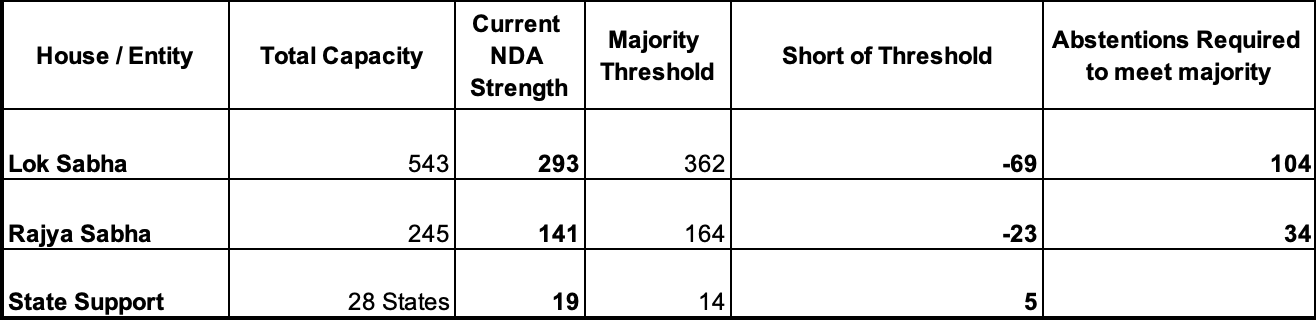
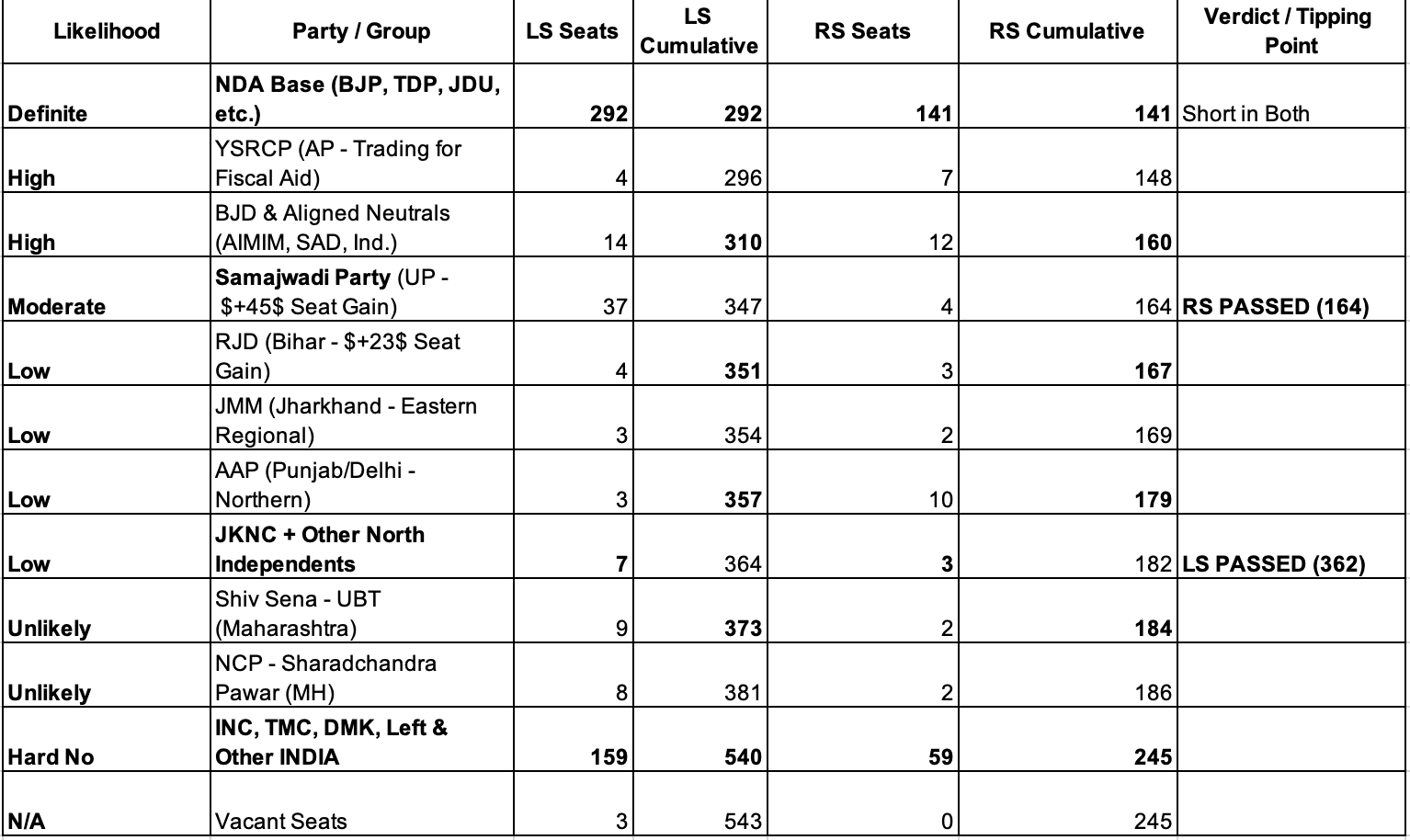
The NDA is unlikely to be able to muster support on the constitutional amendment unless it is supported by abstentions and parties voting along unexpected lines, with the view that they stand to benefit from the proposed amendment.
In matters of Delimitation, we must trust no one. It is a long-term political strategy with immense consequences. The Polity is a buffalo everyone wants to tie in their backyard. Often in these bargains, people stand to lose. Examples of failed delimitation due to non-representation, failure of consensus, court intervention, excessive gerrymandering, and loss of public legitimacy are too many to count and have, in some cases, had serious long-term consequences. Northern Londonderry, Ireland (1922), Kenya (2024)[see chapter 2], Sri Lanka (2017), and New York State (2014) are all examples where delimitation has been intensely contested. India, too, does not have a kind history with redrawing boundaries.
The Political effects of this are obviously likely to spread far beyond the parliament. Mr Stalin has, in no equivocal terms, made this known. Other leaders from the south are likely to join him—Mr Siddharamaiah, Mr Revanth Reddy have already joined the protest. It is, in any case, a cause of national embarrassment that this important legislation was released two days before the session, stealthily and without prior consultation at the peak of the election season in West Bengal and Tamil Nadu. The BJP is mistaken if it thinks it can push this bill through parliamentary deliberation alone without wider consultations with states from Southern India. This is the biggest federal bargain in independent India, and it is unlikely to be an easy roll-over that the BJP is so used to. This bill is but the beginning; a testing ground of a long-overdue struggle to renegotiate Indian Federalism.
(This is an early and quick analysis of the proposed amendment, the bill enacted and its political stakes. I have not dealt here with the Union Territories Bill but only with the Delimitation Bill and the Amendment Act.)