
May I laugh at you, Mr. Prime Minister?
A short edit on the recent cartoon takedown

This video was taken down by the Government citing emergency powers under the IT Rules. Courtesy: The Wire
Recently, an utterly funny cartoon video on the Honourable Prime Minister caused much brouhaha and ruffled the state bureaucracy. The government, in turn, asked Instagram, Twitter and others to take down the cartoon with much alacrity and without even hearing the hosts or creators before the takedown, citing a threat to defence, security and foreign relations. Calling a cartoon based on matters of public record a threat to security and defence is nonsense at best. Given the long tradition of satire, cartoons and irony in Indian Politics, this attempt to regulate humour was unwelcome and imprudent. We must reclaim the space for humour and satire, and this short edit is my bit towards that alone.
Satire in Democratic Politics
A Government that intends to maintain a minimal democratic political appearance must classify ridicule and satire as funny and not funny and nothing more or nothing else. Political Satire subjects politics to lay scrutiny and embodies the essence of a democratic impulse. Satire is a device to retain the serious spirit of the political material while unshackling it from the institutional facade that gives it a divine appearance. Especially, where the state machinery operates in a reified maze of august rules and projection of charisma, the smallest gaps in those provide an avenue for human emotion to enter and flourish in those gaps and widen them. Humour is the most natural of human emotions accessible to all. Satire then ensures that democratic politics remains a healthy space in touch with human feelings. Satire facilitates the participation of citizens in discourse and aids the growth of a political consciousness in democracy.
Satire and Cartoons in the Indian Tradition
Indian tradition has long recognised that power has a serious moral and psychological problem, and power must be immune to routine embarrassment at the hands of thinkers, poets and the media. Kavayaha Nirankusha is the age-old wisdom: A poet alone is unrestrained, and wings of her flights of fancy ought not to be clipped for any reason. The Supreme Court in Devidas Tuljapurkar propounded this global view: “There is no authority that gives a license to a poet. These are words from the realm of literature. The poet assumes his own freedom, which is allowed to him by the fundamental concept of poetry.”
Humor and Satire are essential artistic expressions of a democratic citizenry’s moral courage. People’s moral courage then acts as a limitation on power. Acharya Vinoba verbalised the idea of moral courage as an ankush (Lohia’s Maryada, JP’s Lok Shakti are in a similar vein) on political leadership. Without this ankush of moral courage, democracy risks becoming a theatre of obscure rituals. Satire is but one expression of this spirit and must be constantly guarded from usurpation or capitulation by the State. In DC Saxena, the Supreme Court advanced this view, holding that even vehement, sarcastic and unpleasant criticism of public officials cannot be stifled as it encourages a politically sophisticated electoral debate.
Even a novice-level cursory look at the biography of Indian tradition on satire is sufficient to tell us how much the Indian culture has valued its right to political satire and ridicule. Harishankar Parsai and Sharad Joshi in Hindi were the torchbearers of Hindi political satire. Raghuvir Sahay and Akbar Allahabadi in Urdu; PL Deshpande, VP Kale and Acharya Atre in Marathi, Cho Ramaswamy in Tamil; Nabarun Bhattacharya in Bengali and umpteen others have named and ridiculed the greatest of political leaders in India. Indian folk tradition, including the Tamasha in Maharashtra and the Bengali Jatras thrived on satirising political leadership and their acts to deliver them to the commonest of the commoners with humour. Scores of Bhakti poetry thrived on satire on God-complex, the moral order, the priesthood and all classes holding power. Mushaira and Hasya Kavi Sammelan housed political satire and were enjoyed by the political leadership and the citizenry alike. Satire and Humor as a civic virtue was recognised, and persons with special skill in satire were always celebrated in the tradition.
Cartoons form a rich and modern subset of this tradition of political satire generally. Gajendranath Tagore, Shankar Pillai, RK Laxman, Rajendra Puri, OV Vijayan, Abraham, Sudhir Tailing, Manjul, Surender and Satish Acharya robustly represent this tradition in India with global competence. Bal Thackeray and Cho were both cartoonists who later became politicians. Indian Cartoonists considered it their duty to irritate institutions. To borrow the phrase of the brilliant American cartoonist Herblock, these cartoonists routinely “afflicted the comforted and comforted the afflicted.” Likeness and exaggeration are turned into a mirror to expose irony. They shocked us out of the mundane and the routinised through irony and humour.
Legal Standard for Cartoons in India
The general standard for defamation of public officials is in itself very high, and unless an opinion was said or written with evident malice or a thing purporting to be a fact was stated with reckless disregard for truth, it did not amount to defamation of public figures. This test from the American judgment in Hustler (Sullivan extended to parody) has been repeatedly cited by the Supreme Court in R. Rajagopal, Shreya Singhal, emphasising the inherent subjectivity of “outrageousness”. Party officials may never like anything said or done about their leader. That, however, cannot be the standard to assess cartoons. The learned Kaul J. then, in the Delhi High Court, in Khushwant Singh, enunciated the need for public figures to be thick-skinned to criticism about their public functions and even private life. Political leadership in a democracy is subject to even vitriolic criticism and must take it in stride to make necessary course corrections. A Cartoon about the Prime Minister’s public functions, like the cartoon-video in dispute, is immune at this level itself.
Cartoons are a special form of satire because they leave a lot more to the reader’s imagination. The Indian Press Council Norms acknowledge that cartoons must be treated liberally in a special category and have more leeway compared to other satire and parody when assessing press conduct. In Yorty v Chandler, the California Court of Appeals was adjudicating on an allegedly defamatory cartoon against the mayor, dismissing the appeal, safeguarding the right of artists to exercise hyperbole for rhetorical purposes under the First Amendment. The court opined that: “The genius of a well-conceived political cartoon lies in its ability to communicate in graphic form a statement of editorial opinion which might otherwise require paragraphs of written material to express. To say so much with so little, the political cartoonist makes extensive use of symbolism, caricature, exaggeration, extravagance, fancy, and make-believe.” Cartoonists combine description with a leap of imagination to expose the irony. Reality, authority and aura yield to imagination in cartoons. Exaggeration in character or in narrative is both liberties of the cartoonist as well as a right of the audience. The exaggerations in the disputed cartoon-video were all for humorous effect and are constitutionally firm.
A cartoon is seldom drawn by the cartoonists with the intention to make the reader believe that what is drawn is the truth. There lies an opinion underlying it, expressed with a creative liberty to exaggerate the fact sought to be conveyed. The Delhi High Court too concurred in Ajay Gautam, noting: “Lies made in the context of satire and imaginative expression are not really lies at all and perhaps not even statements of fact because no reasonable listener could actually believe them to be stating actual facts.” A cartoonist could even go beyond the bounds of good taste and conventional manners. The disputed cartoon video, however, only asserted facts that form a part of the public record.
The law always envisages a reasonable person and a responsible context-sensitive reader, and not a touchy and hyper-sensitive individual. In Jothisaroop, the Madras High Court wrote of the cartoonist, “the art of the cartoonist is often not reasoned or evenhanded, but slashing and one-sided. One cartoonist expressed the nature of the art in these words: The political cartoon is a weapon of attack, of scorn and ridicule and satire; it is least effective when it tries to pat some politician on the back. It is usually as welcome as a bee sting and is always controversial in some quarters. In the very nature of things, a cartoonist is entitled to a greater latitude.” The Bombay High Court, too, quashing the sedition case against Aseem Trivedi (Sanskar Marathe 2015), the cartoonist, re-emphasised that cartoons without any incitement to violence could not be said to be disturbing national security or causing disaffection against the state.
Concluding
The Prime Minister’s cartoon video that was taken down said nothing objectionable and stated all things that were a matter of public record with hyperbole and exaggeration for humour. It may have dented his apparent authority and punctured the narrative of mettle and gallantry. That, however, is the day job of a cartoonist. There is no merit in the argument that this restraint was in the interest of security, defence or foreign relations. Shaping a democratic citizenry needs careful political restraint and moderation. Constitutionally, the right of cartoonists and satirists is structured to safeguard and maximise the possibilities of expression for cartoonists and satirists. Political satire is a carefully cultivated political entitlement that the Indian people have received as a timeless heritage. Gag orders issued against cartoons without hearing and citing an emergency have a chilling effect on the possibilities of humorous expression. There are growing concerns about repeated acts of digital censorship. The PMO may do well to take a page from this illustrious Indian tradition of satire and cartoons and join the political culture that laughs off adverse humour to say: “don’t spare me”.
References:
Amul runs a series of cartoons from 1966 to today. RK Laxman cartooned in the Times of India for fifty years. India today ran a series “So Sorry” for eleven years. Shankar’s weekly featured cartoons for 27 years. Manorama, Anand Bazaar Patrika, Loksatta, and Dinakaran have all continued to publish satire and cartoons in the vernacular.
India has also had a tradition of published volumes of political cartoons. Here is one on Ambedkar, Nehru, Gandhi and cartoons by RK Laxman (here for his many volumes), Rajendra Puri. Here was the life of Nehru in a video made as a collection of Shankar Cartoons.
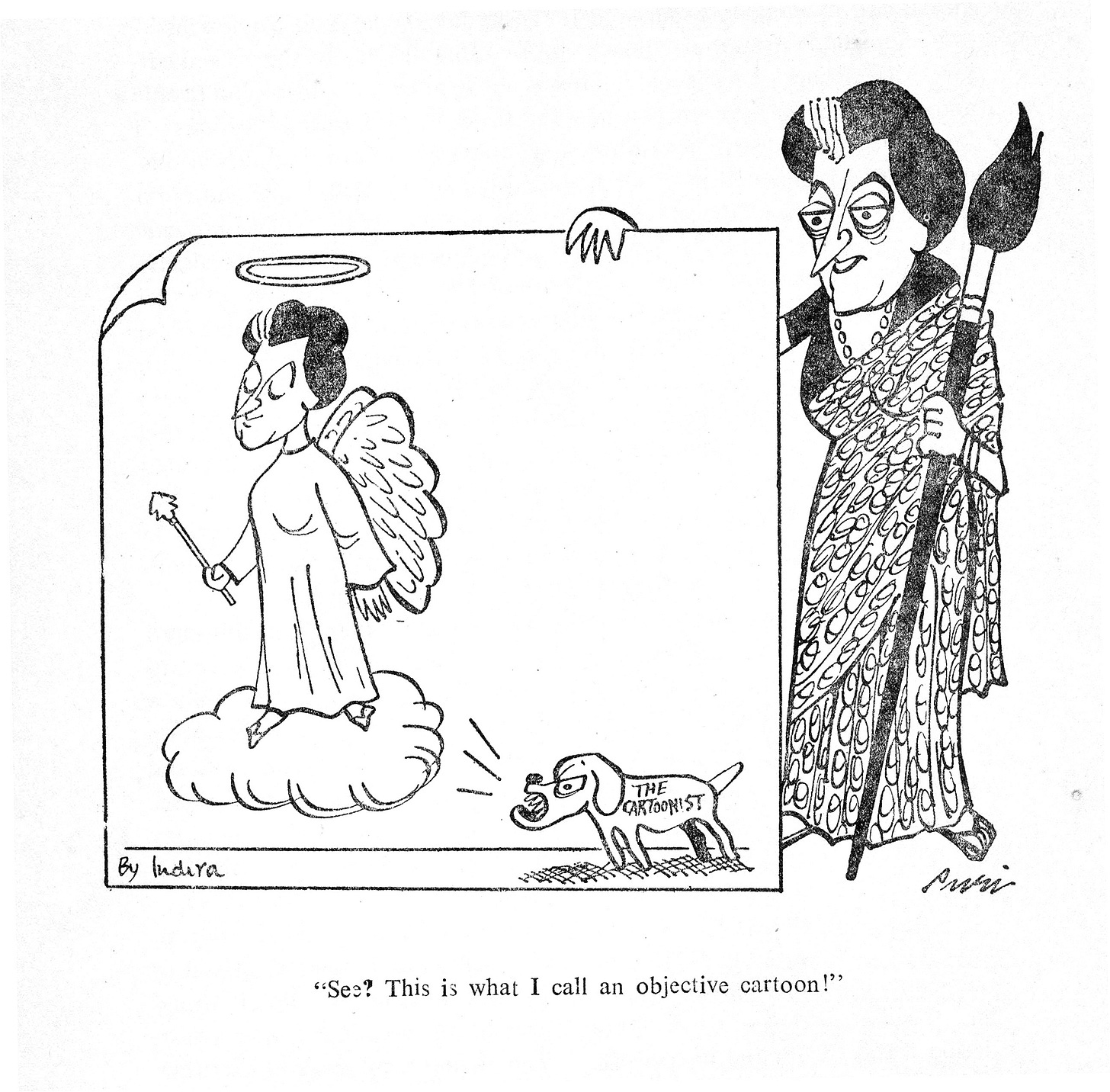
By Rajendra Puri:
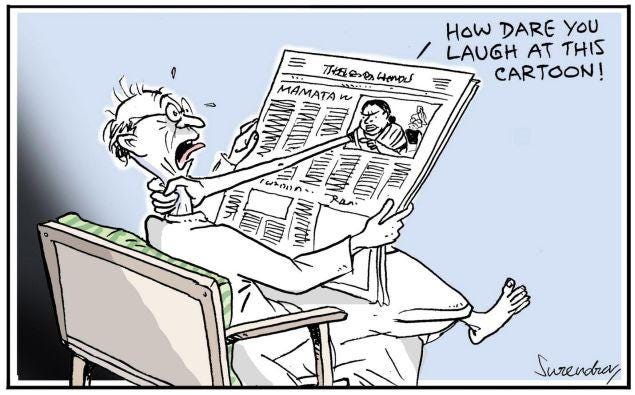
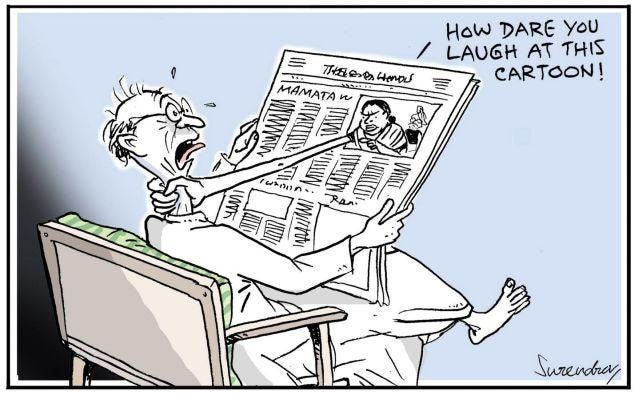
Surender on Mamta:
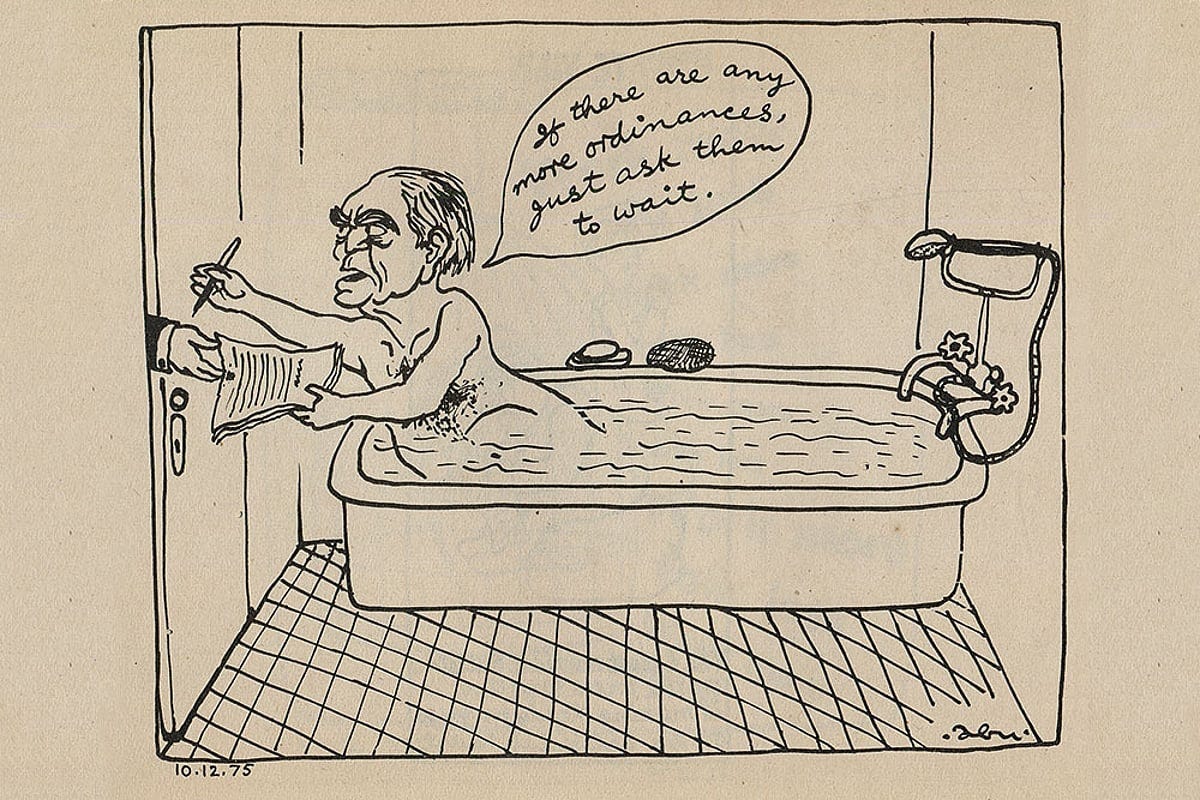
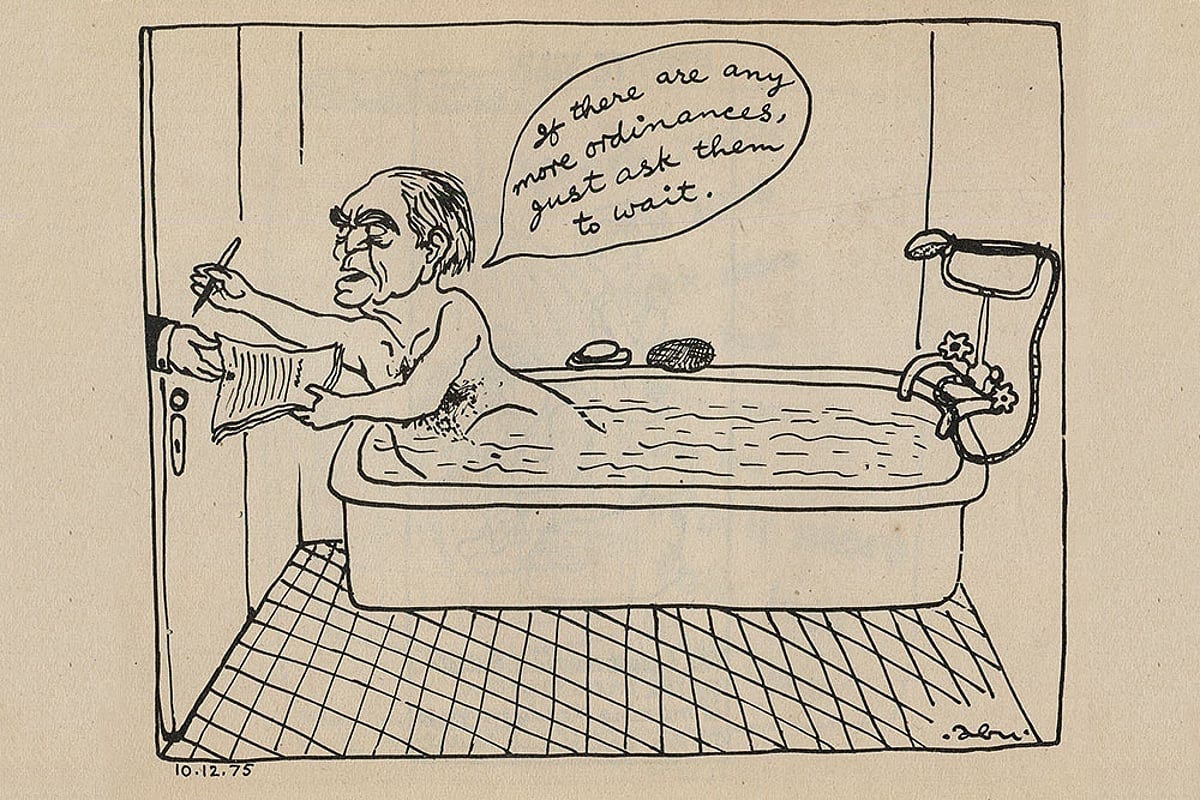
Abu Abraham on the President’s office during the Emergency
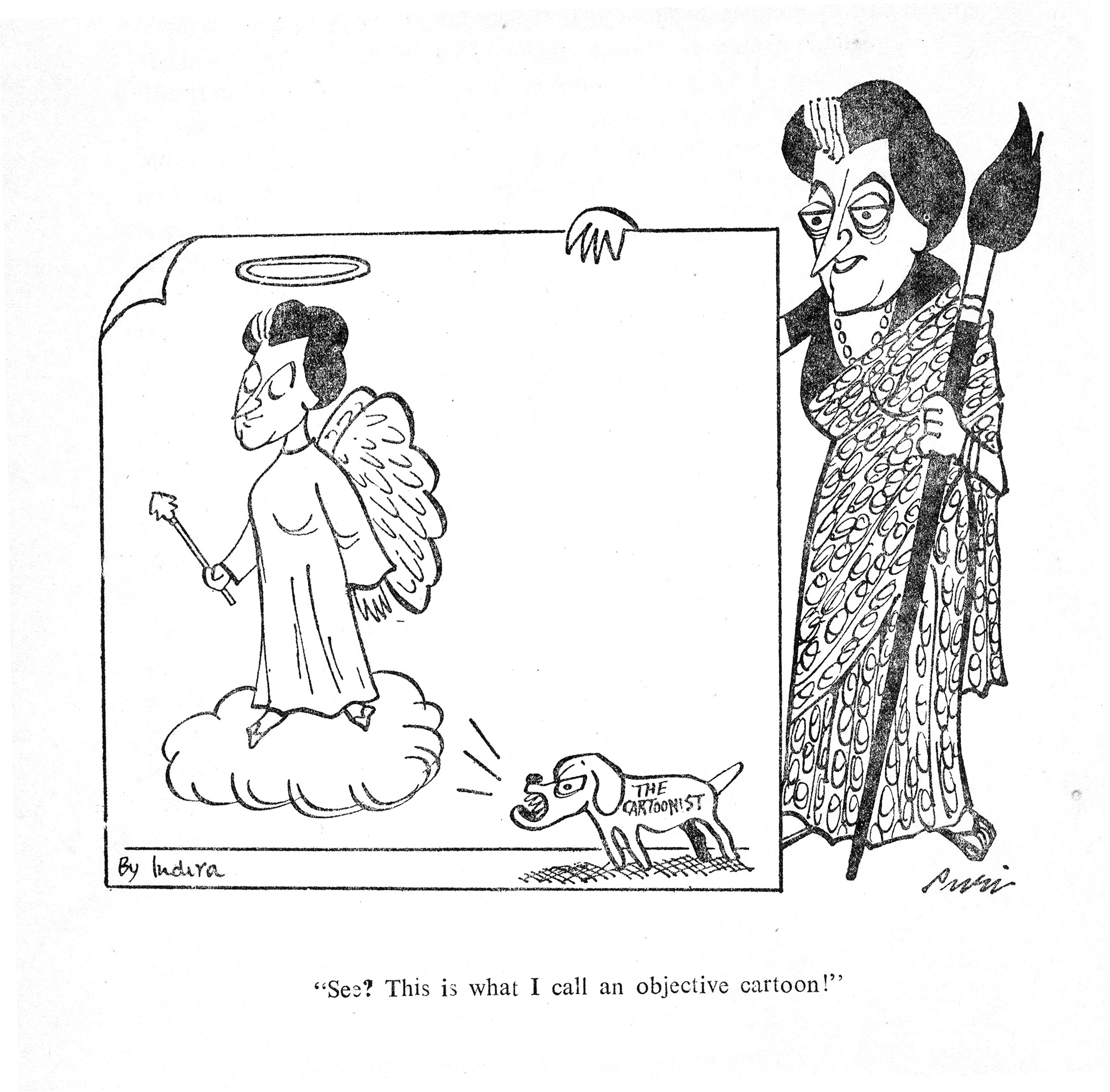
Permission not granted. If you still do so, consequences will be harsh😁😁