
Challenges in Reinstating Eggs in the Legal Debate on Malnutrition
A reiteration of data and a sketch of legal arguments

Introduction
Eggs are an unusually nutrition-dense and cost-effective food. One of the most critical interventions in child malnutrition can be the provision of hard-boiled chicken eggs in school Mid-Day Meals (MDM), Anganwadi meals or raw eggs as a take-home ration for children and pregnant mothers three days a week. In this article, I will make a brief case for the provision of eggs and make a case for re-examining the dicta in Swaraj Abhiyan to defer to the Government on the question of choosing means to resolve malnutrition.
While the idea may seem a stretch, I locate it in the extant jurisprudence on nutrition, right to life, right to equality and the Convention on the Rights of the Child. I will first demonstrate why eggs in MDM and rations are a cost-effective and easy-to-implement solution that can reap abundant gains without effective alternatives. I will then try to inquire into whether such a change is possible by petitioning the courts.
Empirical And Administrative Justifications
Two eggs a day can help meet up to three-fourths of the daily protein requirement of a five-year-old child[1]. Eggs are a rich source of riboflavin, good fat, calcium and vitamins A, B1, B2, B3, B6, B9, B12 and D3, which are otherwise difficult to get in vegetarian alternatives[2]. There is abundant evidence on the effectiveness of eggs in reducing child stunting [3]and improving school learning outcomes like cognitive development[4] and attendance[5], and doing so safely[6]. The National Institute of Nutrition recommends eggs for children as a full meal[7]. The Food and Agriculture Organisation nutrition handbook recommends eggs as a key protein source. Fifteen Indian states already provide eggs in school. Besides, the World Food Programme’s school feeding programmes also regularly serve eggs. Brazil, Peru, Rwanda and South Africa mandate eggs and animal-source protein.
Two eggs cost about eight rupees per child per day. The gains in learning and nutrition far outweigh the costs of providing eggs; are largely progressive and can lead to better outcomes for women too. Eggs are easy to procure locally, need minimal cooking, are safe and beneficial to children's health and are often loved by children. About 14.5 crore children aged 5-16 are enrolled in government schools, and 9 crores between ages 0-6 are enrolled in anganwadis in India. Despite the National Food Security Act, 2013 (NFSA), the growth and nutrition outcomes in children have continued to be alarming and may have worsened.
According to government data, 37.7% children in anganwadis are stunted[8] and 17.1% are underweight. Protein deficiency is the driver of malnutrition in India. Nutrition deficiency in early life affects cognition and intellectual abilities in ways that are incurable in later life[9]. Loss of height and weight suffered early in life, too is incurable. Deficiencies in pregnancy, too, have similar life-lasting effects on the child[10]. Improving the nutrition of the citizens is a primary constitutional duty[11] of the Indian state.
The Problem
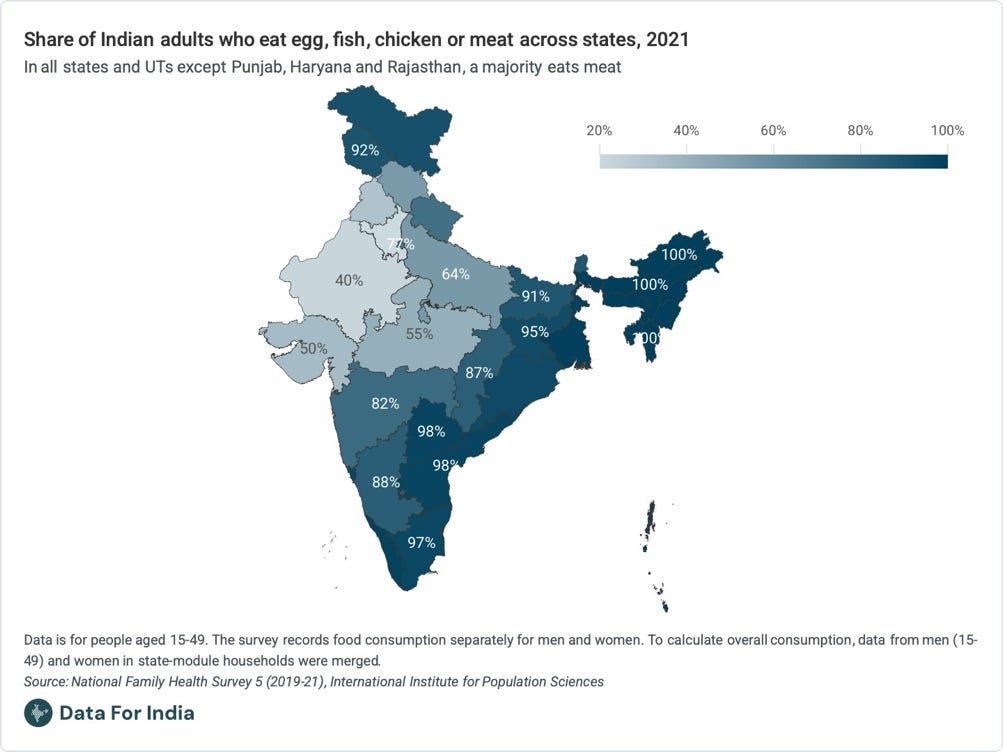
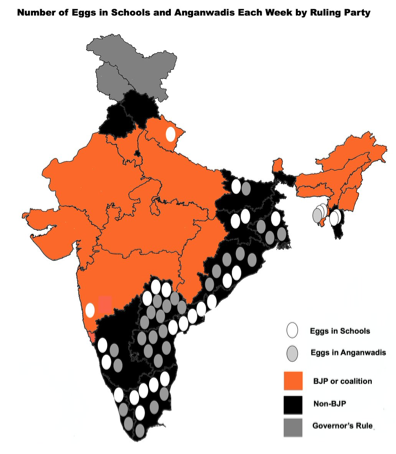
Yet sixteen states,[12] including some of the largest and poorest states in India, do not provide eggs in schools or anganwadis. There are four political-ideological reasons for this. First, it is alleged that providing eggs in schools compels or induces vegetarian students to eat eggs. This can be easily rebutted by requiring written consent from parents or allowing eggs only as take-home meals. Vegetarian alternatives like bananas are now provided by other states and can also be provided. We could also begin by limiting the distribution of eggs to Aspirational Blocks, many of which are predominantly tribal. Second, eggs offend vegetarian morality and religious sentiments of Hindus, Jains and Sikhs, among others. Eggs in MDM or rations would be on a voluntary opt-in and withdrawal basis. Depriving a large population of the right to life and nutrition because of a vegetarian is a smaller and more powerful numerical minority in most states is constitutionally infirm and disproportionate. Third, it is argued that non-vegetarian diets can have an ill influence on children’s moral upbringing, making them violent or otherwise uncouth. This is entirely unscientific and is an argument without any evidentiary basis, and is founded on stereotypical unscientific myths about psychosomatic relations between diet and demeanour. Fourth, eggs offend historically dominant cultural preferences regarding dietary purity. Scholars on purity have rebutted the idea as a vestige of caste-hegemony alone. The proportions of vegetarianism in India are overstated for cultural approval and actually remain even lower than reported. This challenge too cannot be an insurmountable barrier to children’s nutritional safety.
Source: Data for India
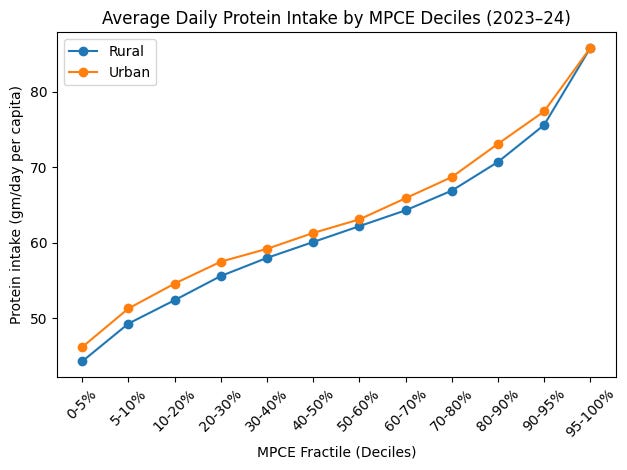
The communities in which malnutrition is highest, that is Scheduled Castes and the Scheduled Tribes, are 87% and 88% non-vegetarian. 90% population of the poorest 20% people, where the malnutrition is highest, have a non-vegetarian diet[13]. A blanket state-wide prohibition on allowing eggs in MDM is without any lawful basis and an unwarranted exercise of state paternalism that entrenches dominant ideological preference. It comes at a great cost to our children, as no food comes even remotely close to packing that much nutrition per rupee and with that much ease of delivery as an egg. Protein intake also varies by income deciles. This is borne out across surveys[14] too. High malnutrition in India is also concentrated in specific districts and even blocks, including many tribal districts. This data must guide decision-making [15].
Source: NSS Survey on Nutritional Intake in India
The Legal Question
While there is abundant evidence on eggs as a superfood and while a large population seeks to enforce their right to nutritional security, political constraints create problems in procurement, distribution and a consistent policy concerning eggs. The National Food Security Act created a statutory right to sufficient proteins and calories, along with micro-nutrients[16] for children and pregnant women. The statute does not, however, prescribe particular food items as essential parts of the diet. All guidance on eggs being a superfood comes from secondary scientific literature and does not have much legal force except being in the broader umbrella of right to adequate nutrition.
In Swaraj Abhiyan[17], the Supreme Court rejected a writ specifically seeking to give eggs and milk under the NFS Act in drought-prone regions, holding that the states had discretion to decide how the necessary nutritional standards are met but had to implement this mandate of sufficient calorie and protein outcomes independent of any financial constraints. The States argued that there were equally effective vegetarian alternatives that would be preferred and the court was inclined to accept that argument.
The Courts, in light of the separation of powers and absent verifiable and judicially manageable standards, are wary of intervening in areas of policy and choosing appropriate policy instruments, state resources, etc. in matters of socio-economic rights and rightly so (See Baker v Carr for a clear exposition).
However, in the last decade, states have consistently failed to deliver the nutritional requirements to the children through effective alternate means, as was undertaken in Swaraj Abhiyan and as is required in the NFSA. This discretion vested in the state as a matter of policy has now collapsed into constitutional abdication. Discretion under Swaraj Abhiyan must therefore be reinterpreted and understood as being conditional upon outcomes, not permanent immunity from review and must therefore be agitated again. This could provide a window for eggs to be reintroduced in this legal debate.
Judicial deference must exhaust itself when the state continuously fails to deliver the mandate, especially of a constitutional right’s inviolable core—that is, the right to adequate and best possible nutrition as a part of right to life. As such, the dicta in Swaraj Abhiyan, ought to be revisited. The Indian Supreme Court must slowly move to adopt a heightened scrutiny of means in cases of socio-economic rights, following the tests of reasonableness and proportionality evolved in later jurisprudence, where the state fails to make effective alternate means available AND fails to secure the outcomes.
The state must justify why effective alternatives are not adopted when they exist. This approach is especially necessary where policy failure produces irreversible harm and where the beneficiaries—children and pregnant mothers—lack political voice. We could draw inspiration in making this argument from the Minister of Health and Others v Treatment Action Campaign and Others 2002, and the Grootboom line of cases in the South African constitutional court, to open an alternate avenue for scrutinising the means adopted to achieve socio-economic rights without encoding any direct minimal core of rights that the Indian Supreme Court has been averse to.
Some strategic caution
This issue obviously cannot be framed as a demand of the form that courts prescribe menus. It is a demand that, where statutory nutritional outcomes are persistently unmet, courts review the exclusion of demonstrably effective interventions under a heightened standard of scrutiny. The solution is for the court undertake a means analysis when outcome-achievement fails, provide for a transparent audit and mandatory reporting of outcomes as required in NFSA. Nothing more, nothing else. Eggs are not a question of policy but are an inevitable and effective alternative to secure right to nutrition as required under the NFSA.
Further, for such a move to succeed, the consensus on the nature of socio-economic rights of children, especially about malnutrition, must slowly shift within legal academia and the legal fraternity to become a) outcome-focused and b) less deferential to the government. Without these, it is difficult to press for a legal demand for eggs when vegetarian alternatives appear to have failed to be as effective. More research is also needed to i) demonstrate the effectiveness of eggs in Indian schools and to ii) independently (not state funded reports) examine why the state’s child nutrition programs have failed to deliver outcomes, especially in terms of diet diversity and intake of protein and vitamins.
The Courts have adopted a deferential attitude in matters of socio-economic rights, especially in prescribing particular means. That is the biggest barrier for any petition instituted for a writ that eggs must be served in schools. Anxiety about competence could be addressed by demonstrating continuous failure to meet the mandate of the NFSA and asking courts to merely review that failure without more. Evidence by way of affidavits and data must also overwhelmingly outweigh even the slightest concerns of ideology. A carefully demonstrated budgetary burden and cultural sensitivity framing can reduce government resistance
One way to minimise harm to the adjacent community rights if any, and address concerns about separation of powers, is using the judiciary to intervene at the level of particular blocks, districts or specific marginalised communities rather than seeking a state-wide mandamus demonstrating continuous failure of the NFSA mandate over a long period of time to show that excluding eggs has been hitherto devastating for the children. High Courts are more obviously better equipped to provide such localised remedies. That power can then gradually be expanded.
We should also plug any argument on slippery slope by demonstrating i) the gravity of the crisis, ii) the irreversible nature of the crisis, iii) the existence of an effective solution, iv) assuring that this solution is peculiar and distinct, and this won’t lead to a spillover into jurisprudence on socio-economic rights generally. Even a court order requiring the state to consider the feasibility of giving eggs after representations are made to the officers by senior experts will be a significant gain.
The court has also held that the nutritional standards in the NFS Act were the minimum, and the state could certainly exceed that mandate. Eggs can therefore continue to be provided as a supplement to the meals, as they exist. In PUCL v Union of India[18] the Supreme Court emphasized that a state that does not respond to hunger despite having the means to do it fails in the duty imposed upon it by Right to Life under Art. 21. It is thereby crucial to subject this issue of whether provision of eggs is a prudent idea or not to constitutional scrutiny rather than leaving it entirely to a political negotiation that leads to gross failure in meeting statutory mandates.
If political concerns pertaining to faith must inform the policy of egg-distribution, it must be constitutionally balanced against the vegetarian citizens’ right to faith rather than abandoning it to political negotiation. The court will be ever hesitant to take up such a role and rightfully so. One must therefore also not bring this up unless necessary and inevitable.
It is useful to pursue the line that circumstances are extraordinary and may need thinking beyond usual doctrinal pontification on the balance of rights. We otherwise risk losing an entire generation to malnutrition despite having an acceptable solution. To reiterate, there is in any case no coercion to eat eggs, especially with safeguards such as necessary parental consent. The right to choice of food has been recognised as a part of an individual’s right to privacy too[20]. The scheme can certainly be implemented in a manner that allows both rights to be preserved.
The argument on faith must be minimised. However, if it becomes inevitable, the right to religion[22] provides freedom from state coercion and is subject to other fundamental rights and concerns of public health. Malnutrition has remained a massive public health crisis in India. This case could provide a good avenue to introduce and expand minimum core standards in Indian law. The right to religion cannot be read to enable dominant groups to impose their preferences on state-welfare concerns in matters of fundamental rights to life and maintenance of public health. Statutorily[23], this mandate can also be situated in the NFSA, 2013, without any need for new legal enactments.
Eggs are the least restrictive means of achieving the statutorily mandated nutrition requirements. The alternatives are relatively more expensive, difficult to deliver or not as nutritious. There is no equally effective means that is widely available and can be delivered easily, either. Where the state has failed to discharge a burden, the burden of proof of suitability and necessity of means must lie on the state. There shall in any case be no infringement of individual liberty to not have eggs and persist with vegetarianism. This safeguard can also be further strengthened by requiring parental consent or by allowing only take-home rations rather than serving in-school to ensure voluntariness. The Convention on right of the child require attaining the highest attainable standards of child health.
Finally, on balance, the right to nutrition is sacrosanct, and the future of children depends on its survival or failing. The limitation of the group right of vegetarianism is not disproportionate to what is required to meet the nutritional requirements of children and pregnant women. The purpose of the right to nutrition must override moral concerns of vegetarianism and, in any case, cannot be said to be disproportionate. A blanket de facto prohibition on providing eggs in schools because of vegetarian concerns has a disproportionate impact on children and pregnant mothers, as is borne by data on nutrition outcomes.
Exclusion of eggs from meals and takeaway rations as a matter of policy is also indirect discrimination[25] under Art. 14. This too has not been expanded to socio-economic rights and that makes it a difficult argument to sustain doctrinally. Non-inclusion of eggs and inclusion of alternatives is masked as a neutral policy of opting for neutral foods. However, this has had a demonstrable and disproportionate impact on malnourished students and mothers from marginalised backgrounds. This is especially true where vegetarian alternatives are harder to procure and administer, more expensive, and thereby failing in implementation. This leads to insufficient nutritional diversity in children’s and pregnant mothers’ diets. This constitutes structural discrimination against malnourished individuals and turns the constitutional burden cast upon the state on its head by worsening the position of children and mothers already placed adversely.
In Ajmal Ahmed[26], the Kerala High Court did not allow a writ petition contesting dropping meat from the menu in Lakshadweep while fish persisted. The court inferred that diversity in foods is not a mandate of the NFSA or the MDM rules. Here too, the court relied on the dictum in Swaraj Abhiyan. The petitioners did not demonstrate the failure of the NFSA mandate and the existence of alternatives. The court framed this dispute as an exercise in choosing the menu. In an erroneous reading of the mandate under the NFSA, the court did not consider the various aspects of nutrition enunciated therein and stopped short of invoking the writ jurisdiction beyond a textual reading of the statutory rights.
Conclusion
The issue of the inability and unwillingness of the state to enter this political bargain can be resolved by attempting to constitutionalise the issue of egg provision. At the very least, it can open a window for renegotiation and re-entry of eggs in the debate on the judicial side. We must move from a vague right to nutritionally adequate food toward a reversal on burden in favour of eggs as the default means of fulfilling the right to nutrition. The state must demonstrate why a more effective alternative, where it is available and feasible, must not be provided. Eggs can occupy a unique position due to their nutritional density, cost-efficiency, cultural ubiquity, and administrative feasibility — making them distinct from being a gateway to broader non-vegetarian dietary mandates.
State must demonstrate in constitutionally cogent terms—district-wise and outcome-based—why eggs are excluded despite overwhelming evidence of their necessity. Adult moral preferences of specific groups must not continue to dominate the constitutional entitlement of marginalised children to life, health, and dignity. Eggs are administratively reasonable; they are the rights-protective default, and the children bear the cost for the omission. Pragmatism demands that states adopt the distribution of eggs to willing-students as soon as possible. The approach of legalising the issue must be adopted cautiously to not undo the gains of political movements thus far. A favourable court judgment and legal discussion, however, can provide a useful anchor to further this initiative. Even if this fails, an instituted transparency and audit mechanism could go a long way.
Appendix
Source: Swati Narayan, Jan 2024
[1] At an average of 7g protein per day. A five-year-old on average requires 19 g of protein at 1g per bodyweight in kg.
[2] Larson et al. (2024). Egg consumption and growth in children: a meta-analysis of interventional trials. Frontiers in nutrition, 10, 1278753. https://doi.org/10.3389/fnut.2023.1278753
[3] Lora et al. Eggs: the uncracked potential for improving maternal and young child nutrition among the world’s poor. Nutrition Review Vol. 72 Issue 6 2014 https://doi.org/10.1111/nure.12107
[4] Ernyey et al. Effect of egg consumption on early childhood development: evidence from Un Oeuf study. Public Health Nutrition Vol. 28 Issu 2 https://doi.org/10.1017/S1368980024002490
[5] Karnataka mid-day meals: Eggs six days a week have increased attendance, says DSE, The Hindu
[6] Myers, M., & Ruxton, C. H. S. (2023). Eggs: Healthy or Risky? A Review of Evidence from High Quality Studies on Hen’s Eggs. Nutrients, 15(12), 2657. https://doi.org/10.3390/nu15122657
[7] Dietary Guidelines for Indians. (2024) ICMR National Institute of Nutrition, Telangana
[8] Poshan Tracker Database. Figures for 2024-25.
[9] Cabal-Herrera et. Al The impact of undernutrition and overnutrition on early brain development. Seminars in Pediatric Neurology. October 2025 Volume 55
[10] Marshall, et. Al (2022). The importance of nutrition in pregnancy and lactation: lifelong consequences. American journal of obstetrics and gynecology, 226(5), 607–632. https://doi.org/10.1016/j.ajog.2021.12.035
[11] Art. 47
[12] Madhya Pradesh, Gujarat, Maharashtra, Rajasthan, Uttar Pradesh, Bihar, Arunachal Pradesh, Himachal Pradesh, Jammu and Kashmir, Uttarakhand, North-Eastern States except Tripura
[13] NFHS 2019-21. Lower 90% demarcated using asset ownership data as a proxy for wealth.
[14] NFHS 2019-21, NSSO Survey on Nutritional Intake in India 2023-24, NSSO HCES 2023-24.
[15] We have adopted claims based on empirical data in Indian Constitutional Law to demonstrate failure of fundamental rights. Nitisha v Union of India for instance adopts the tests Fraser v Canada to establish indirect discrimination.
[16] S. 4,5 and 6 r/w Schedule II.
[17] Swaraj Abhiyan v Union of India 2016(7) SCC 498
[18] PUCL v Union of India, 2001-2003 Daily Orders under the Continuing Mandamus.
[19] As laid down in the Association for Democratic Reforms 2024 INSC 113 Para 157
[20] Hinsa Virodhak Sangh v Mirzapur Moti Kureshi 2008 (5) SCC 33 Para 18. Also, in Puttuswamy 2019 (1) SCC 1
[21] As laid in Mazdoor Kisan Shakti Sangathan (2018) 17 SCC 324 Para 60
[22] Art. 25
[23] To satisfy the requirement that a statute take away fundamental rights and not an executive order, as required in Bijoe Emmanuel (1986) 3 SCC 15 Para 16
[24] As laid in Shayara Bano 2017 (9) SCC 1. It cannot be said to form the “inviolable core of the faith.” It is wise to exclude this issue as a matter of strategy to avoid being tagged with Kantaru Raajeevaru.
[25] Lt. Colonel Nitisha v Union of India (2021) 15 SCC 125 Para 70
[26] Ajmal Ahmed R v Union of India
Other references: