
A New Age Legal Repository
Enacting a Transparency of Rules Law

Index
The Problem Statement
Every lawyer has at least once been asked to do the impossible: find the exact circular on an issue. What if I tell you all that effort and the Eureka moment were a waste of time and mostly a result of horrible design thinking? Why can’t finding out the exact circular, rule, and notification be as easy as looking up a Wikipedia article?
Discoverability and understandability are two foundational principles of design, says Don Norman, in his “Design of Everyday Things.” However, the current confusion of scattered rules and circulars with endless amendments that no one can usefully track complicates discoverability systematically. One cannot tell what the legal position about most obligations is at a particular point in time without poring through PDFs for hours. From Farmers to Big Corporations, everyone suffers from this. Lawyers, judges and bureaucrats are no exception either. Some of this confusion is inevitable because statutory schemes overlap in complicated ways that are not easy to delineate. But that is besides the point—I am speaking simply to the difficulty of locating the exactly right combination of relevant PDF documents.
There is an old legal adage: Half of being a lawyer is knowing where to look. It is akin to the old joke about the mechanic who slapped a client’s fridge, and it started working— and he charged the client for “knowing where to slap”. Now, AI must render this half, which is just about finding out applicable rules obsolete. But that is not yet the case. This article is about designing a legal information system that is AI-friendly.
This business of tracing legal obligation through a maze of rules is built to confuse by design. There are many cases we find where issued circulars clash against other circulars of the same department or other departments, against orders, and against rules, too. All of this is often because the person issuing the latter circular was hopelessly unaware of a previously existing one. For instance, it took the RBI months of effort to collate some of its circulars into a master circular. Not to mention that this creates rent-seeking opportunities for the “Tax teams” at big firms, for nothing more than simply knowing where to look or for the experience of having looked at the right places before. This is not genuine value addition by creative interpretative guidance or case strategy.
The current system of e-gazette notification of rules is designed for a time when gazettes were printed. We moved from print to PDF without making any fundamental changes to searchability or usefulness, thus not unlocking all the flexible benefits that digital technologies can offer. Insofar as PDFs lock in information without giving searchability, interoperability or the ability to intersperse across rules, it has become a liability in the era of general artificial intelligence and APIs. Mr Sanyal, the PMEAC member, is therefore correct to suggest that we need a Transparency of Rules Act. In this article, I offer some thoughts on a potential design for this Bill.
Complexity of the Regulatory Scheme
Sample this statutory scheme of the Indian Energy sector. Count the number of acts, the number of rules, and the number of regulators. The functions of these regulators often substantially overlap. No matter how hard we try, it is nearly impossible to design a clean scheme of acts and rules from the get-go. To make matters worse, it is difficult to locate the rules. As an exercise, find me the exact notified CCTS rules and their relevant amendments up to date.
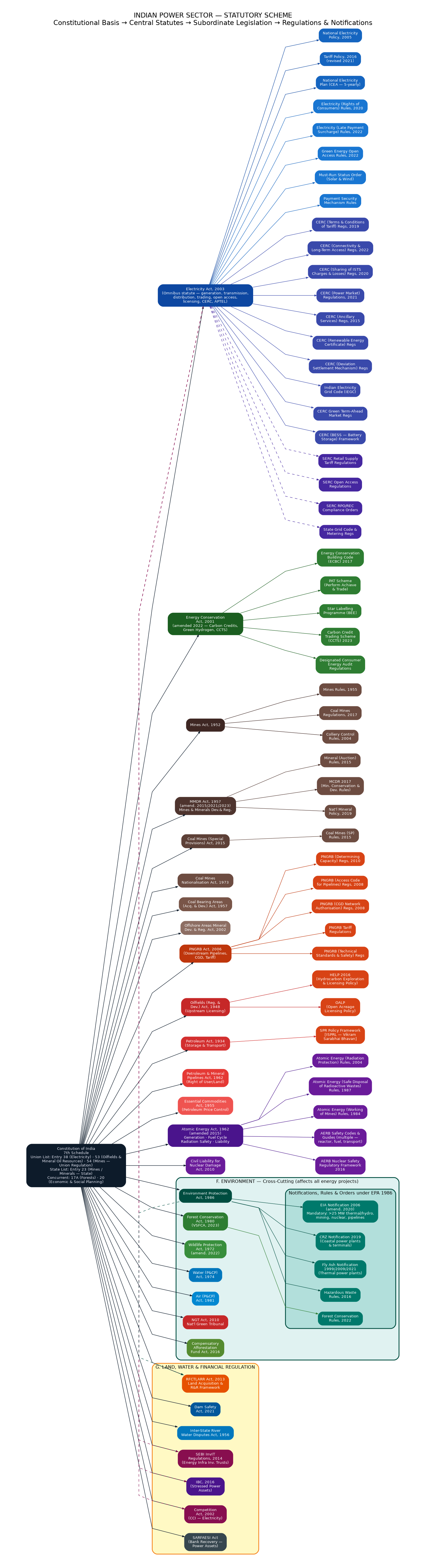
If you think this is true only of the energy sector, sample these graphics for the financial sector. (Thanks, Claude) If anyone wants to verify, the list is here.
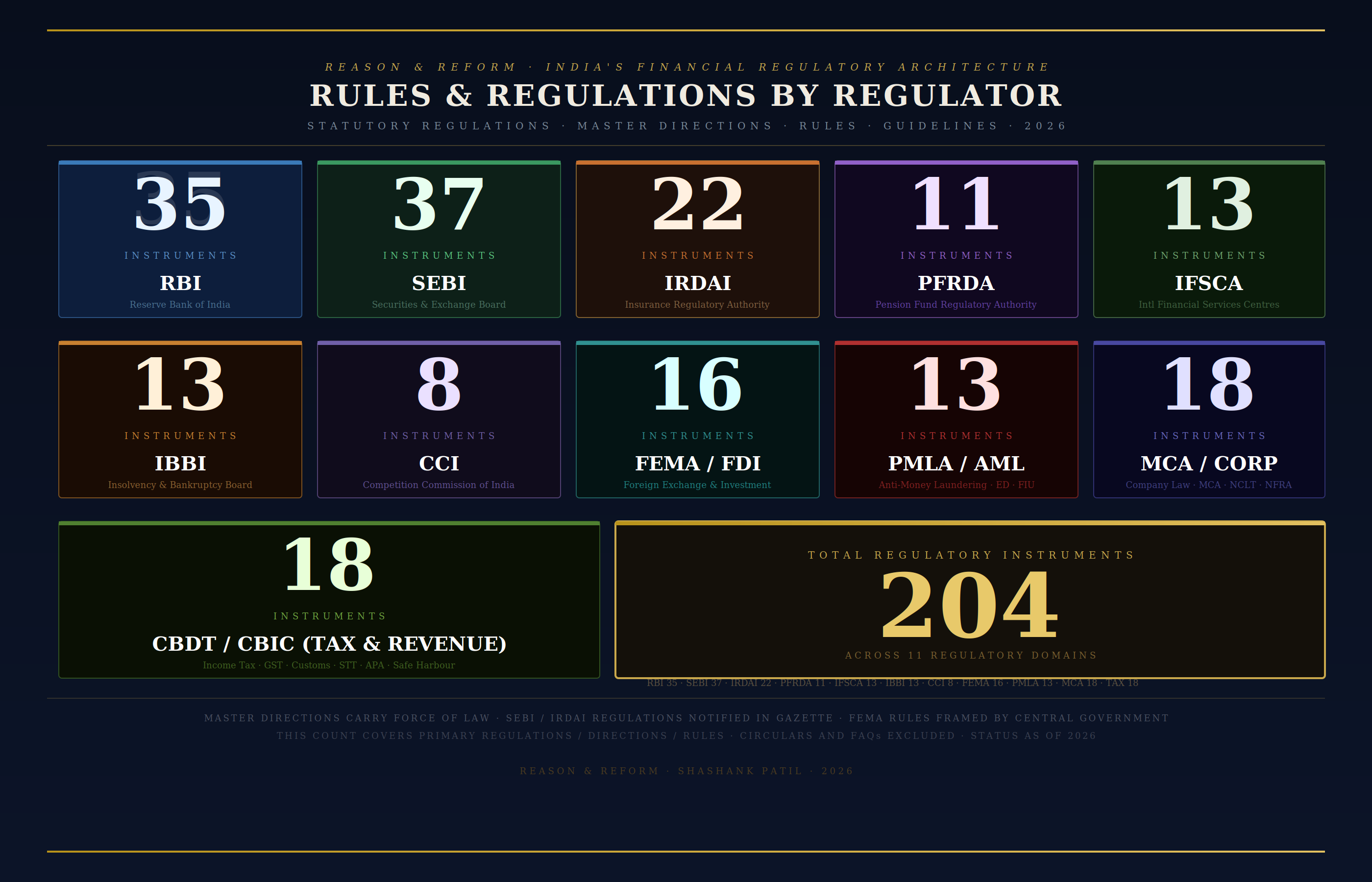
204 Rules and Regulations, and these are in addition to the 60-odd Acts governing the sector. Just having this ring-fencing in place and having a mechanism that enforces it, however approximately and imperfectly, is a staggering achievement. Depending on the complexity of the transaction, however, one must look through multiple acts and rules and their overlap. One must find out which of these acts have been superseded and which continue to be in force. One must find out which rules have been made under which section. How have the cases been decided under that section and those rules before? Because the law does not excuse ignorance of the law, but it is impossible to know all the law at once, lawyers are the priests who help you optimise this gamble with fate.
The Maze of Circulars
This does not stop here. For example, if you are looking at a complex query on income tax, you have to look through one or more of the 1,378 circulars on Income Tax. Again, we do not know which circular is issued under which rule, and which rule is framed under which act beforehand, and it takes work to figure that out. That work primarily involves trawling through PDFs, finding a relevant judgment or asking a senior lawyer. This is not just for income tax. There are:
314 circulars on Central GST already. SEBI has issued 2,774 circulars. Here is the index of thousands of RBI circulars sorted month-wise and year-wise, which is the least useful way of sorting circulars. Both the SEBI and RBI have now begun consolidating these circulars into master circulars, which is a welcome move, but scarcely sufficient. Here are a few hundred of the RBI master circulars. Here are the 134 SEBI master circulars and the 358 IFSCA Circulars. NSE circulars here. BSE circulars here. Central Electricity Regulation Commission regulations and circulars are here. You might think this is special to the financial regulators. You might think this is a malady of the regulators. Here you go: Circulars of the environmental impact assessment, MCA circulars, Drug Control, Food Safety, Department of Expenditure, and Department of Financial Services. Even look-out notices for absconders are MHA circulars.
And these do not include various State-level Departments and their rules and circulars, which are abundantly worse by design. While circulars of the union government and many of these regulators might still be relatively easy to find, rules and circulars of the state government can often prove impossible to find. The most reliable way to find out is to know someone who is regularly tracking these rules, circulars or notifications or using them for arguments. You might be tempted to bribe the bureaucrat so that he may reveal the magic potion, but if he has been transferred recently, he does not know either. This might also be your chance to surprise the judge. Until NIC started building the half-decent e-gazette websites, state government gazetted too were in a miserable state. They still may no work on an unlucky day and have a mediocre user interface that is barely functional. India Code too was started at the behest of the Indian Courts.
Try it on your own
For most lay people, it is impossible to track jurisdiction, statute, rule, circular notification, all of it at once. Let me give you an exercise. Find the Commercial Courts Act. This well-intentioned Act was enacted by the Indian Parliament to give a priority jurisdictional court to commercial matters so that they can be expedited. In the first version of this act, the pecuniary limit was set at ₹3 lakh. Every commercial matter exceeding ₹3 lakh in value had to lie before a special commercial court to which a stricter procedural law applied. Over time, they realised that ₹3 lakh was too small an amount and ended up including a lot of petty disputes. Not to mention the fact that we still are not entirely clear about which subject matters are properly “commercial” disputes, and what is ‘commercial’ anyway.
Eventually, the Union Government realised that there cannot be a single threshold for what is a significant commercial dispute that can uniformly apply across all states. So they introduced a power for each state government to vary this limit of 3 lakh rupees through a notification. I now challenge you to tell me reliably what the current threshold is for commercial matters in any ten states. In one of my internships, while a matter was at the stage of commencement of trial, we pulled this trump card. Neither the court nor the defendant was aware that the Government of Maharashtra had actually issued this notification increasing the limit to 10 Lakh. Therefore, the city civil court did not have pecuniary (legal speak for money-related) jurisdiction (scope of power) to hear the dispute, and it had to be transferred to the commercial court. We worked to find that notification because we wanted the delay. There is no dearth of such examples. Sections, rules, and circulars are disconnected and all located on different websites in intractable ways.
One of the most difficult parts of being subjected to a system of laws is to guess its absence. Where all laws are not found in a single place, it is impossible to tell whether what was not found is merely not found or does not exist. See S. 21 of the General Clauses Act. If a notification has been rescinded, and its gazetted notification cannot be found—God save you. This confuses not just lay people but bureaucrats in equal measure. An officer who has just been transferred to a new office has no way to find out what the web of circulars and regulations governing his jurisdiction is. He must rely on the advice of his juniors, who have been acting under the circulars for many years. For lay people like us, we have no such experienced juniors guiding us and must pay for expensive legal advice just to know what the applicable law is. It does not help to be a person of general intelligence. To be a law’s citizen becomes an exacting roulette.
The precondition for a functioning legal system to serve its epistemic function is that knowledge accumulates. It is easily and reliably discoverable by the citizens and the bureaucracy. Two of the most foundational benefits of this system flow from a definite interconnection between these many rules and circulars. We thus need a single online source of all legal obligations maintained at public cost. This helps all stakeholders and citizens at a pittance of cost to the state. Many gentle-persons have articulated this before. This Daksh report by Sandhya P R, presented by Surya Prakash here, the NITI three-year action plan, Economic Survey 2017 Vol. 2 all articulate a version of this.
Rethinking Design
Have a look at the Indian e-Gazette. There exists a weekly gazette and an extraordinary gazette. The Gazette is issued by the Director of Printing in the Department of Publication in the Ministry of Housing Affairs. Before 2015, we used to print physical gazettes. After which, we have moved to e-gazettes, which is a slow big win. However, the e-Gazette is ill-suited for New Age Law. It only has two categories. Extraordinary Gazette and Weekly Gazette—which mimics its earlier physical form. The PDFs are dumps of novel obligations flowing from the state.
Usefully, the central gazette at least has a free text search and sorting department and date-wise. However, most state gazettes do not even have a free text search feature or any such feature. Most state gazette websites don’t even work on all days. Worse if you are looking for departmental circulars because they exist on department websites, which work even less frequently. You have to know exactly which division has issued the gazette that contains the regulation you seek to find, and also roughly when it was issued, and then also be lucky enough for the website to work. Then, on a combination of date and division, you scroll through a long list of gazettes to land on what you want. There is no chance an educated reader can find out the exact rules with notified amendments and schedules, and read them with other relevant rules and circulars. To make matters worse, the circulars issued so often are not even gazetted documents. As such, they must not bind anyone whatsoever; yet they do create obligations. What follows is a way of re-imagining how Indian rules are promulgated.
a. National Legal Repository: Hierarchical Presentation on a free public website
To get rid of the endless circulars, require that all circulars be consistent with other circulars and be promulgated rule-wise, with direct reference to the rule under which they draw power. Likewise, all rules issued under a section must be available and sorted section-wise. All amendments to the rules must be linked in one place. These must be classified in a hierarchized, searchable database where clicking on a statutory provision takes you to relevant rules and clicking on a rule takes you to the circulars relevant to those rules and the statutory provision. This must be done for all the statutes, rules, and circulars issued by all departments, central, state or municipal across the country.
b. All laws updated and the ability to export the law at any point in time
All laws—Acts, rules, and regulations must be shown only as the latest version on this central website. Further, a separate table in each act/rule must maintain a record of all the amendments. See this example from South Africa of the PAJA Act’s amendment history on the first page of the Act:
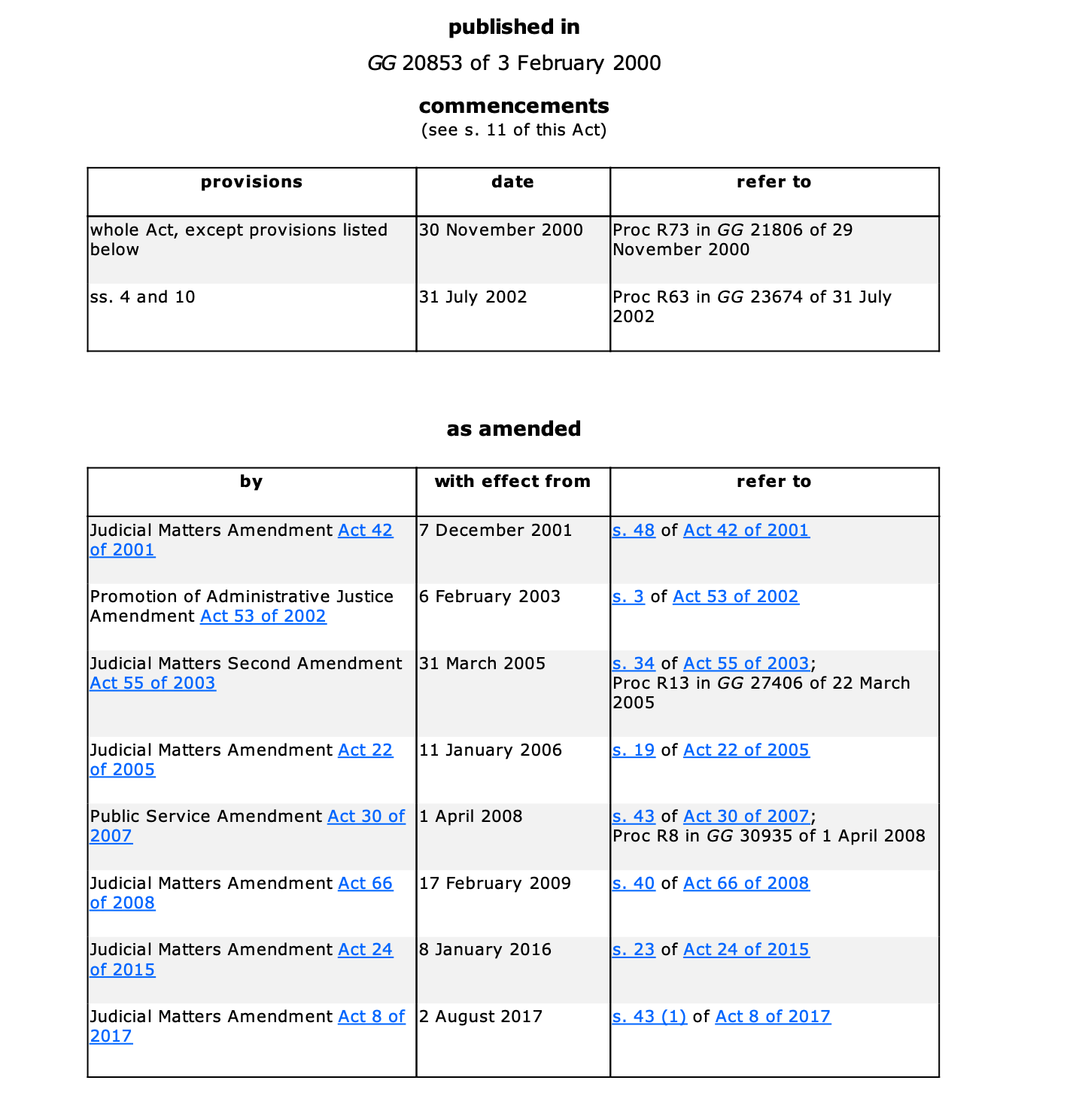
This ensures that all amendments are known to citizens, and they can know exactly when the law changed and what those changes were. All the amending Acts are linked here. If we persist with PDFs, they must link the amendment index to the particular section and not act as a whole. The website should have the option to export any particular act, rule, circular, or combination (the whole, not parts or sections) thereof as on a particular date through a matter of a few clicks with an accurate timestamp. This being the official version drawn from the website, it must be citable across courts in India as the authoritative source of law. Anything that cannot be output as a result of this clicking cannot be deemed to be binding the citizen at that time.
Until we upgrade to this new system, we must urgently do away with the senseless practice of repealing amendment acts. Amendment acts don’t incorporate laws into the original body of the statute in the existing scheme of things. They provide a mapping between the previous unamended statute and the new amended version. Twenty-five years later, the amendment act is an authoritative source of telling what was replaced with what.
c. Alternate to a. and b. Reform the Gazette to be a centrally-maintained, searchable repository
All Central and State Gazettes must maintain a complete master index sorted by Act, Rules and circulars that is entirely searchable and hierarchised. India Code must exist only as a site that provides footnotes, comments and other value-added services on top of the Gazette. Not a substitute. All India Code Entries must expressly link to the relevant entry in the Central Repository Index. We could redo the Gazette to be this central repository. Amend the General Clauses Act to specify that anything not on the gazette website in the specified form shall not bind. Amend the General Clauses Act to modify the Viraj Impex line of cases on the nature of publication that creates a legal obligation.
d. Uniformity across States and Central Funding
All state gazettes must also be brought within the sweep of this reform by amending the General Clauses Act through the exercise of the residuary power in Information Technology and the mode of promulgation for uniformity across states. Run this as an entirely centrally funded project with a sunset clause and conditional funding. States that do not wish to be on board within twelve months will have to do these reforms at their own cost.
e. Strictly Machine-Readable Repository
No officer should print a document and scan it back-that is a deprecable practice for any rule, regulation or circular. It may be permissible to a limited extent for quasi-judicial orders that affect only the parties before the officer. Get rid of scanned PDFs as a default mode of presenting output. Ensure that the rules and statutes can be exported as XML/HTML/Plain Text files, which are all searchable and may be exported as PDFs for a particular date-time stamp if it is desirable that the rule must be printed. Akoma Ntoso in Africa has done it with much fewer resources; we certainly can imitate it. This OCR-readable documentation of laws also makes the statutes and legislation visually disabled-friendly and consistent with the RPWD Act. That itself is a great anchor for this entire reform in a politically astute way. Make it a disability-first reform.
f. Allow a low-fee Public API Service to fund this project
Build a public API on top of all this data for payment of a fraction of the fee. Let people work with this legal data to create topologies of legal obligations and then work to simplify process reform. Let people train good AI models and query this data at will. That is the future and is consistent with the latest AI rules issued by the Supreme Court. This will also streamline the interface between rules and judgments and the production of accessible and AI-translated commentaries in the future. At a minimum, allow private entities to export all gazettes daily, reorganise the records topic-wise and allow for a searchable database of rules and regulations. These enable automated amendment tracking, AI-assisted legal research on current law (not historical PDFs), and alert systems when a provision affecting a citizen’s rights is amended.
g. Move away from the Department of Printing to a separate department
If the Department of Printing is too burdened, create a separate National Legal Registry in the Legal Informatics department in the Ministry of Law, liaising with the NIC directly. Change Business Rules to reflect this. The SC, the High Courts, the Ministry of Law, the district courts, MEITY, and NIC all need a coordinator. Treat this as a priority.
h. Searchable Judgment Database, but exclude them from mandatory reform
Make all High Court and District Court judgment databases searchable and with neutral citations like the DigiSCR. Constitutionally, these are courts of record and their judgments have a precedential value. Urgently make all the private legal databases obsolete. Allahabad High Court has a version with a very bad User Interface that is worth replicating with a better user interface. Enter a contract with Indian Kanoon and other such tech not-profits and formalise this so that it is available free for all citizens. Their work has had an immense impact. Alongside High Court Judgments and Supreme Court Judgments, implement a system to search important daily orders. The law on bail and interim relief is more important to citizens than the current searchability allows. All cases must have a designated Case ID that tracks the case through the entire system, the moment it enters any court anywhere in the country. Revamp the e-courts project to implement this long-pending reform. Assist the judicial side with officer deployment and financial support cut out explicitly for this. QR tag all Case IDs. Allow procurement of a certified copy of any judgment entirely online at the payment of a very small fee to generate revenue for this project if there is a shortfall. Thoroughly improve the enforcement of eCourts 4.0. Eventually, all acts, rules and circulars under constitutional challenge must be flagged as such in the National Legal Registry.
i. End the private stranglehold of copyright on judgment text
SCC, Manupatra and the ilk’s copyright must only be limited to the headnotes, not the body of the judgment, even with their editorial labour; especially given that the new judgments are increasingly well-formatted and machine-readable. Particularly, SCC Online’s non-scannable TruePrint must end. The DB Modak case needs prospective overruling eventually. The databases should compete on analytical tools, case notes, etc. End the citation monopoly.
j. Fix responsibility for the maintenance of the National Legal Repository
If the Gazette site of any state is down on any day at any time, the officer concerned must be subject to adverse remarks and penalties. It should work at all times. Create structured monetary liability clauses on whichever website and entity hosts this information. Anything that is not on the central repository cannot bind. Not even by waiver or acquiescence.
k. Replicate the repository across mirrors for potential safety breaches
The entire project must be replicated on all state nodes through a limited-purpose and small blockchain-like replication and minimal write-authorised nodes for enhanced cybersecurity. We must aspire for the most advanced standards of cryptography. Indian Cert-IN has failed us repeatedly. It needs a new world-class vendor selected through a transparent auction, and for guarding sovereign legal knowledge. We must continue to maintain offline copies of the entire legislation database, as well as a printed Gazette consistent with the framing of this new design, to ensure the integrity and security of records in case of cyber attacks. However, the offline Gazette or the physical Gazette may be relied on only if the digital records are subject to an attack. The most recent and excellent way of ensuring this reform is learning from the New Zealand Legislation Act of 2019 and the lessons therein.
l. Distinguish Rules, circulars, notifications, etc.
We do not yet have legislation that distinguishes rules, circulars, notifications, OM, with specific power, procedure and obligation expressly. While it is clear that the constitution> statutory law> rules under the law, the effect of the rest of the instruments is unclear. The form of the document issued, whether a circular and office memorandum or otherwise, is not what decides whether it is a binding rule or not. It is the substance of the document—what that document actually purports to do—that decides whether it is a binding rule or not and who it binds. Therefore, for many circulars, one must wait for a court decision to understand their binding value. The law does not allow ignorance of the law as a defence. There is then a corresponding duty to publish the law in the best medium of dissemination available and make the law known. To make matters worse, the State Government and Central Government have original executive powers where they can issue notifications, guidelines, and circulars without any reference to an enabling statute passed by the competent legislature, as long as they don’t infringe fundamental rights or an existing statutory law. Amend the General Clauses Act to clearly stipulate the difference between an act, rule, regulation, notification, circular, including the nature of obligations created. India must adopt a clear typology of legal instruments: the defined internal procedure of the agency, regulations that bind the world at large, notices about clarification of the purpose of the rules/regulations that are strictly non-binding and are issued before the rules are promulgated, not as an afterthought and finally, an office memorandum that only binds members of the bureaucracy and no one else and so forth. The format, relevant issuing authority, and the procedure for issuing any of these must be statutorily fixed. India could also formalise procedural requirements, such as public consultation, before rules and regulations are promulgated. S. 23 of the General Clauses Act stipulates such procedure; however is often not followed and is non-binding.
m. Adopt a Last Shot Rule on Circulars
Indian Courts use ad hoc devices — sometimes temporal priority, sometimes hierarchy of issuing authority, sometimes subject-matter specificity. They treat the conflict of circulars as an issue of interpretation. The prudent course must be to adopt the last strike rule. The circular later in time is the only one that can bind or a deference rule, i.e., a circular that benefits the non-state party binds the department.
Bureaucracy and Rules
One of the most important ideas the literature on state capacity often misses is that state capacity has a legal-epistemic dimension. State capacity requires the creation of an intermeshed web of rules and the deployment of intelligent capacity to implement those rules. To build a Weberian bureaucratic state, therefore, is not just to produce particular role moralities and bureaucrats who occupy those role moralities. Weberian bureaucratic state also requires the creation of a system of rules that are applied fairly, justly, and equally to all instances that are approximately the same. Now, there is the catch. Wittgenstein once told us that all problems of philosophy are problems of language. This applies pro tanto to bureaucracy and law. Doing things with rules requires repeated iterations of what a particular phrase means, and if a thing X was covered by a phrase, will a thing Y, which is similar to X in some ways but different from X in other ways, still be covered by that same phrase? Bureaucrats must give us reasons as to why a particular phrase that covers X will now not cover Y. And then there is a time limit, accepted form and procedure and all that accompanies this exercise. Law is about reason-giving and reason-making; so is a modern democratic bureaucracy that is expected to answer with reference to rules. The point is simpler to deliver home now with this prelude in place: To build a regulatory state, we need actors who are capable of devising a web of rules, and actors who interpret those rules, give them meaning continuously over time, and issue clarifications about what those rules mean or don’t mean. Over time, this mode creates advanced and sophisticated moral knowledge with a high degree of specialisation about what is allowed and not allowed within that sub-system. This mode also creates an attitude of the actors— the bureaucrats, the citizens, and the judges—towards accepting the consequential moralities inherent in this web of rules and maximising possibilities in its interstices.
However, circulars and rules that cannot be found with much effort and cannot be tracked fail even the minimum requirements of the rule of law. Circulars issued without reference to the enabling rule, and rules issued without reference to the Act, likewise must fail as void and without power. India has no general administrative procedure statute, no statutory typology of instruments, and no statutory publication standard for circulars. And all this when all the rules and circulars may not even be discoverable on our own in their most up-to-date form. We all then live at the mercy of judicial review. Even judges in the lower judiciary do not have access to all the rules and circulars and must depend on lawyers. The discoverability of rules, acts and judgments is crucial to the success of any legal system, and we (lawyers or otherwise) must strive for it. This has a clear upside of clear notice of laws to all relevant parties.
We need to establish a National Legal Registry with State Nodes that is the single, secure and digital source for all laws, enactments, rules and circulars. Initially, we must exclude judgments of courts and tribunals from this exercise, but eventually, all sources of law must be available at a single source in a text-searchable, disability-friendly format for free. Whatever is fed into the state node becomes law and is automatically discoverable through the National Legal Repository. Here is a Transparency of Rules Bill, 2026 draft for consultation that we may work with.
Even if we do not accept this reform wholesale, we can learn perhaps from the ECtHR in its plenary powers in cases of interference with rights operates under a doctrine of “Quality of Law”: to satisfy the ECHR requirement that an interference with rights be “prescribed by law,” and the law must meet two conditions: (i) it must be adequately accessible — citizens must be able to indicate the legal rules applicable to their case; and (ii) it must be sufficiently foreseeable — citizens must be able to regulate their conduct accordingly. An agency’s interpretation in an informal document is not binding on courts could earns weight proportional to: the thoroughness of its reasoning, its consistency over time, its validity, and the agency’s expertise. Legal Force must be directly related to its procedural form, appropriateness and discoverablity. Lon Fuller notes that being ruled by law respects our dignity as agents who can intelligently respond to demands; law must encourage reflection— and for that reason be discovered easily.
Email with comments at reasonandreform@proton.me.