
#8 Updates from Law, Economics, Policy
Indian Economists, New research on Teacher discretion, Apex Court of Governor's Assent, Nuclear Energy is resurfacing in India

Azim Premji University releases a series of articles introducing some distinguished Indian Economists who are no more with us
Economists who have paved the way for original economic thinking and institution-building in India. A magnificent galaxy of thinkers! All written by economists and academics of high caliber.
Those on Prof. Padma Desai, Prof. Mahalanobis and Dr. IG Patel remain my favorite stubs thus far as I read along.
“Bhagwati’s trade theory and Desai’s sector-level analysis further showed that import substitution produced high-cost domestic industries within protected markets. They advocated abolishing licensing in non-strategic sectors and adopting flexible exchange rates. The response to these ideas was, at best, lukewarm, and mostly deemed radical in the 1970s. But eventually, this book was foundational to India’s big-bang reforms in 1991. She deepened this analysis through subsequent monographs (Desai, 1970; 1973) examining import substitution patterns across industrial items and evaluating India’s tariff system.”
This one is from Prof. Padma Desai’s less known work. The website will be updated with more entries. Which prominent names do you think are missing?
This new paper finds large effects of remedial education consistent with the literature, but no differential effect of discretion on learning in Odisha Schools. Needs Unpacking, hence this part.
Study features:
Remedial Education of the curriculum from class 3 to class 8 to class 9 students. Three-phase prep — Class 5 and below level, Class 8 level and grade level.
Remedial Education of two types: Standard Remediation and Emphasizing flexibility to the teacher and expecting flexible teaching according to a flexibility plan
No direct input effects: Implemented during the existing School Day with existing teachers
Non-scripted lessons. Daily outlines provided.
Important Caveats:
The Average Teaching Experience of teachers in the study is 15+ years. Experienced teachers employ flexibility well and know how to do it better even when not instructed or without using plans, and may even be inclined to do it as a general practice.
70 %+ of the sample take private tuitions, which reinforces what is taught in class with an accentuated emphasis. That casts some doubt on effect sizes.
85% students have literate parents, which might interact with flexible and standard teaching treatments to dilute both.
75% of headmasters believed teachers should adhere to the curriculum, and 95%+ agreed that curriculum was central to teachers’ jobs; the inertia of the curriculum thereby remains high.
Drawbacks:
The longer-term outcome relies on a weighted average of class IX and class X marks for class X results because the board exams did not happen. This confounds teacher perception and student performance making them indistinguishable. There is no unbiased instrument available to separate the two effects.
2% attrition—Lee Bounds are presented and are consistent, but caution is warranted.
Qualitative Inquiry into Implementation fidelity was poor or nearly absent. We do not know for sure how a standard teaching classroom differed from a flexible teaching classroom.
Teachers in both standard and flexible arms embraced limited flexibility, and most did not complete the flexible remedial plans. Only 4% more teachers in the flexible arm felt they had more autonomy as compared to standard arm.
It also appears that the program may had limited success in displacing the curriculum, however led to very effective remediation overall.
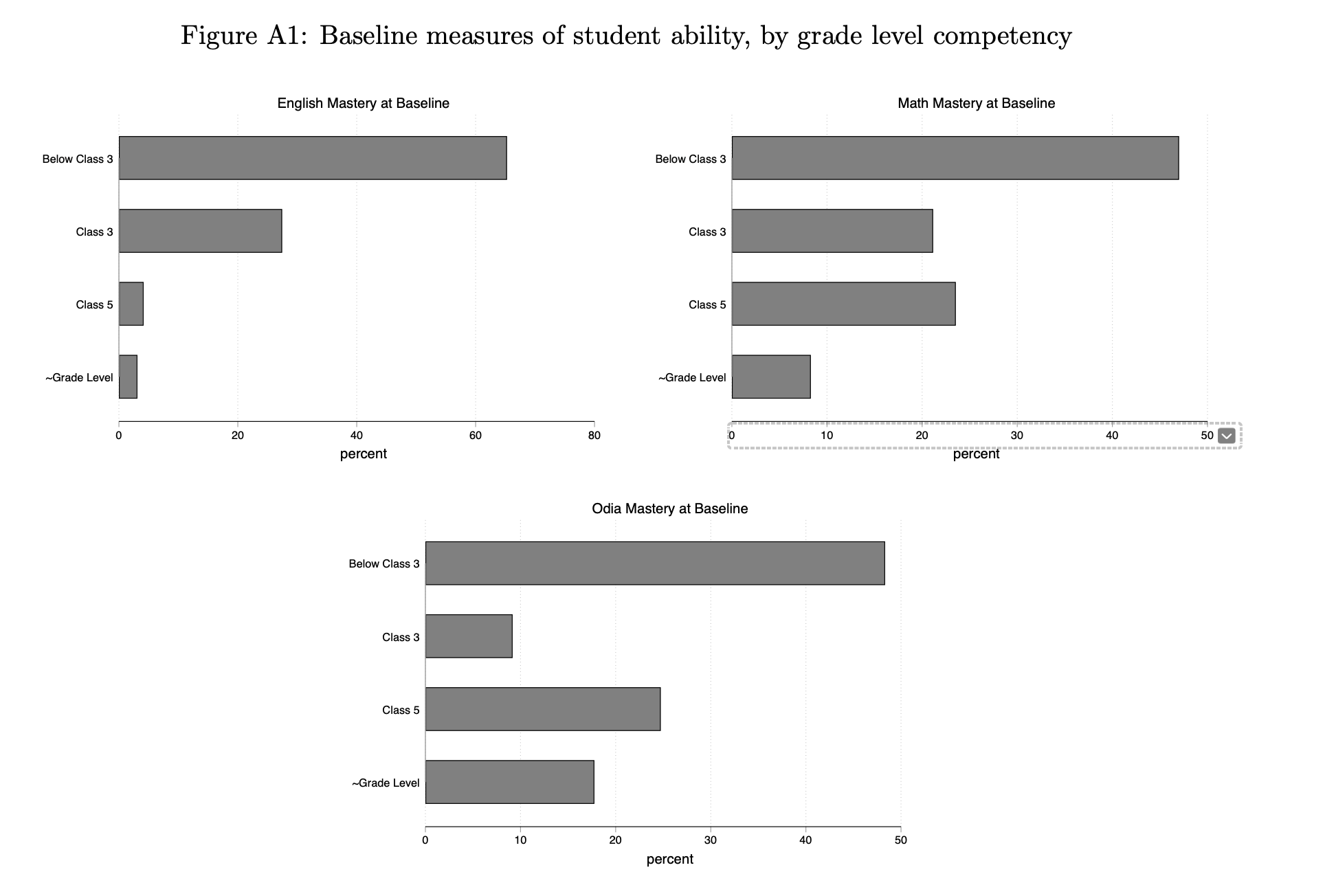
Baseline Statistics— Class 9 Competencies
Important Outcomes:
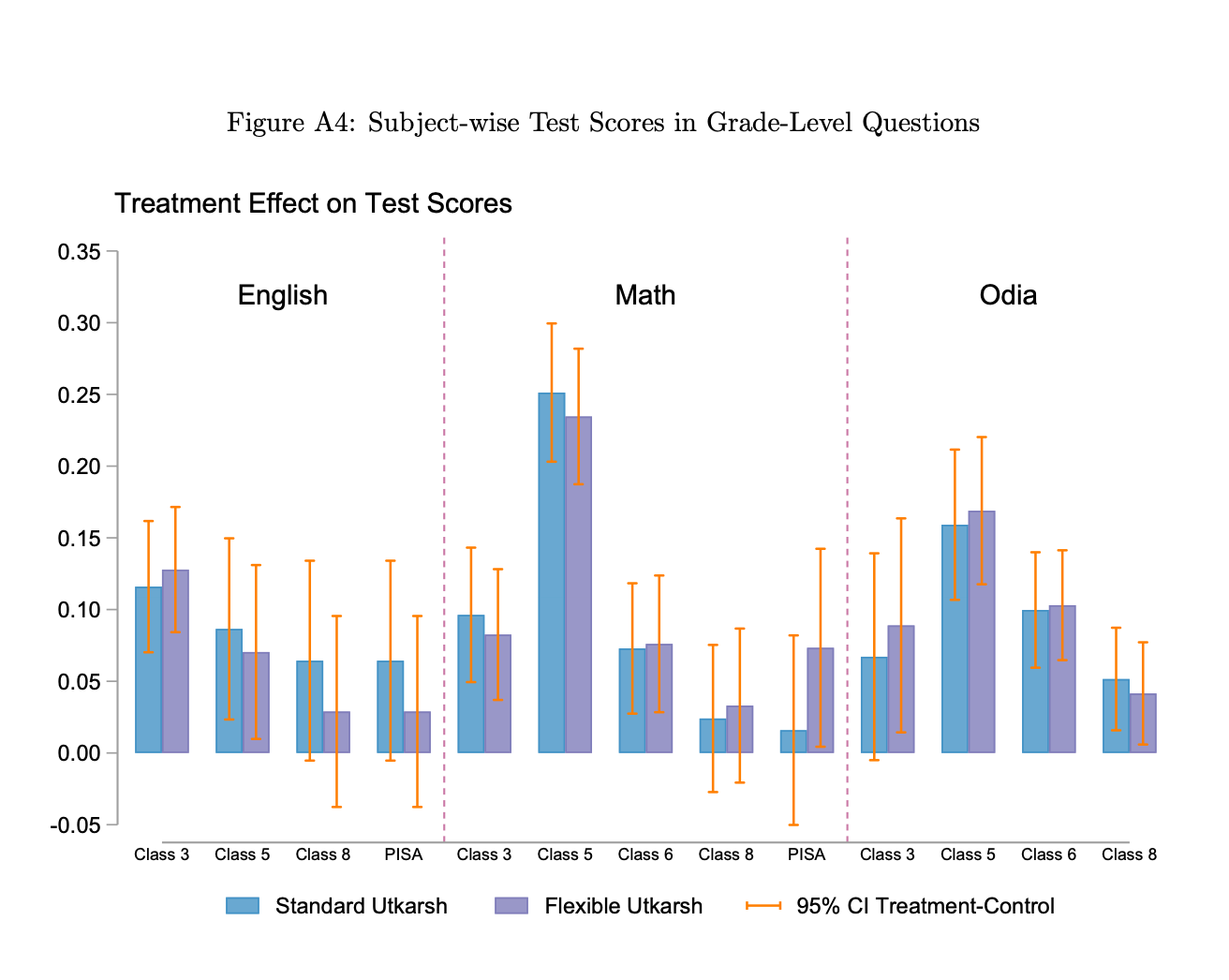
Remedial Education improved test scores on sub-grade level competence. But grade-level performance in class IX and class X, as measured by a weighted average of in-class scores in school, deteriorated by 0.16 SD. This can be explained by teacher perception or actual student performance but it cannot be stated with certainty which of the two is the likely cause of poorer student scores.
Remediation corrected teachers’ expectations to match student reality more closely, which is inherently a good outcome.
There was no difference in outcomes across Standard or Flexible Remediation. But nothing more about flexibility and its use can be inferred in absence on detailed observational data on the exact differences in implementation sanctity of standard and flexible remediation.
State of Tamil Nadu v The Governor of Tamil Nadu. Also reported here.
The Tamil Nadu Constitutional Deadlock on the Governor’s blockade of bills passed by the Tamil Nadu Assembly was finally resolved by the Apex Court.
The Court laid eight issues for decision. Important amongst those were:
1. When the legislative assembly has passed a Bill and presented it to the Governor for assent, but the Governor withholds his assent thereto, and as a result therefore, the legislative assembly passes the Bill again, and presents it to Governor, will it be open for him to reserve the Bill for the consideration of President, more particularly when he did not reserve it for the President when it was present at first instance.
…
5. What is the effect of the expression 'shall declare' used in the substantive part of Article 200? Can a time-period be read in Article 200 in which it is expected for the Governor to pass a declaration?
…
7. When the President directs the Governor to return the Bill and the Bill is passed and presented again to the President, in what manner is the President to act?
The Apex Court reiterated the 2023 State of Punjab v Principal Secretary decision that the governor cannot exercise any form of veto over bills duly passed by state legislatures. The Governor sought to argue that he had withheld assent because he feared repugnancy of state laws with Union law. However, in the scheme of Art. 200, he could have referred the bills to the president when bills were duly presented to him or could have returned them to the assembly with a message stating his reasons for withholding assent. This would enable the assembly to pass the bills with the necessary amendments it deems desirable.
If, on the first instance, the bills are not referred to the President by the Governor, he ought to return them to the assembly. The court had to decide what to do when bills are passed again by the assembly in the interim when Governor has withheld assent but neither returned the bill nor forwarded it to the president. The court held on the interpretation of Art. 200 that it is binding upon the Governor to provide assent to the bills so passed. Relying on Shamsher Singh, it declared the observation in BK Pavithra on the Governor’s power to withhold assent independently of the advice of the legislative assembly to be per incuriam. The court reiterated that the Governor had no independent discretion under Art. 200 and had to act on the aid and advice of the legislature. The court stressed that there was no absolute or pocket veto available under Art. 200.
Art. 200 is reproduced for convenience with the operative words in bold:
“Art. 200. Assent to Bills.
When a Bill has been passed by the Legislative Assembly of a State or, in the case of a State having a Legislative Council, has been passed by both Houses of the Legislature of the State, it shall be presented to the Governor and the Governor shall declare either that he assents to the Bill or that he withholds assent therefrom or that he reserves the Bill for the consideration of the President:
Provided that the Governor may, as soon as possible after the presentation to him of the Bill for assent, return the Bill if it is not a Money Bill together with a message requesting that the House or Houses will reconsider the Bill or any specified provisions thereof and, in particular, will consider the desirability of introducing any such amendments as he may recommend in his message and, when a Bill is so returned, the House or Houses shall reconsider the Bill accordingly, and if the Bill is passed again by the House or Houses with or without amendment and presented to the Governor for assent, the Governor shall not withhold assent therefrom:
…...” (Emphasis added)
The Apex court then went a step further, and the ten bills were deemed to have been assented to by the Governor/President in exercise of plenary powers under Art. 142. This is radical because of these ten, seven had been rejected by the President for repugnancy with Union law. The Court still recognised the power of the assembly to make the laws. The Court also laid down a timeline for decision and assent by the Governor. This subsumption of the Governor’s powers under Art. 200 by the Supreme Court is unprecedented in Indian Constitutional History.
Full judicial opinion is awaited.
Nuclear energy is making a big comeback.
Amazon, Google, Meta vow to triple Nuclear Energy by 2050. Gen AI needs power. Private AI Companies have already acquired captive Nuclear Sources.
India appears keen on restarting the Nuclear program with renewed interest. India has a “100 GW Nuclear by 2047” Nuclear Energy Mission. The Budget announcements were a clear signal in the direction of major reforms in the sector. This is central to India’s AI ambitions, and hopefully, the policy momentum will persist.
The Union Government is considering:
i) Shifting Nuclear Energy to Ministry of Power
ii) Opening up to private players
iii) Amending the Civil Nuclear Liability Act—especially S.4 and S.6
iv) Amending Atomic Energy Act— S. 3, BJP’s own 2016 amendment to S.14(1A) notified in 2023, S. 22, S. 23, S. 24, S. 25
v) Increasing capacity within NPCIL and NTPC JVs
vi) SMR R&D and SMR policy
vii) A future opening up of foreign investments.
Fin.