
Front-line teachers, Middle-Bureaucracies and School Education
Book Review: Lessons in State Capacity from Delhi's Schools

About the book
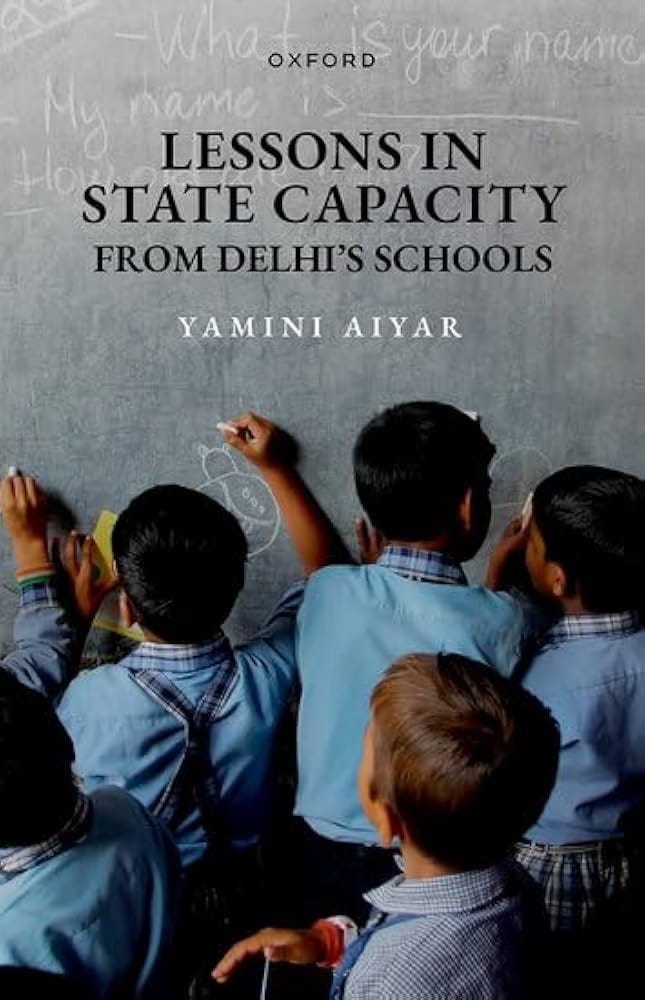
In writing about the challenges of Indian Schooling, I previously alluded briefly to the challenges of State Capacity. Yamini Aiyar’s new book on frontline bureaucracy in education double-clicks onto this problem by studying bureaucratic experiments in Delhi Government’s Primary and Secondary Schools. The book is rare for its careful focus on the frontline bureaucracy, on which the literature is thin. The other literature, e.g. Natarajan, has focused on a macro-review of capability and capacity problems. The book seeks to “unpack how the state sees, talks and commands itself into implementation”. It encapsulates a competent review of theories of state capacity.
Pritchett’s summary of the book
To get frontline to hear you saying something different you have to say something different.
One also has to say it differently. Further, one has to prescribe “what to do”.
Send clear directions with training and support to the frontline.
The middle bureaucracy muddles, focus thereafter on the middle.
Axes of intervention
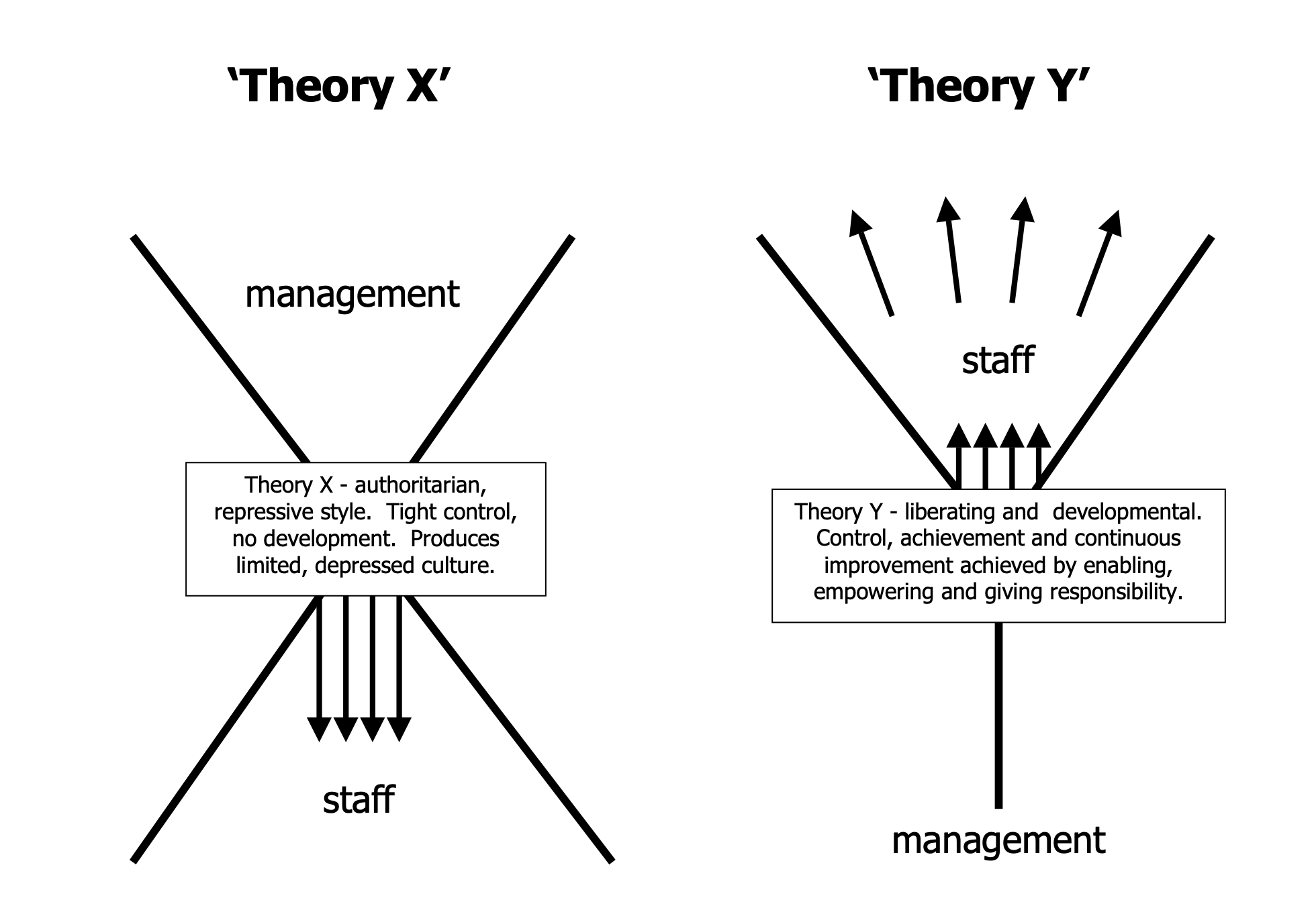
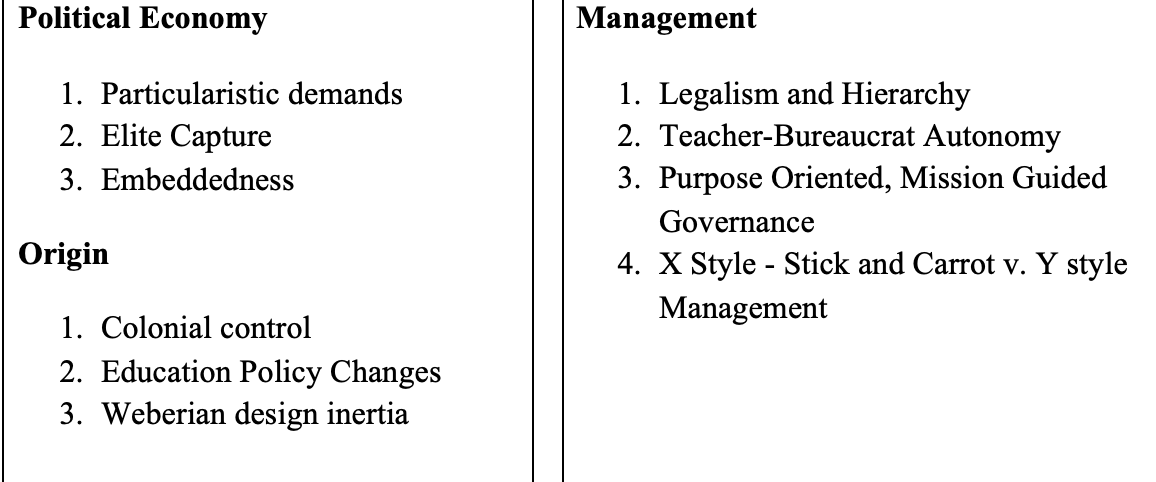
After distinguishing capacity and capability, Yamini discusses autonomy— from local elite, higher bureaucracy, from circulars and compliance cultures, political demands, particularist demands and competence— in exercising moral agency, efficiency, in using discretion, effective feedback mechanisms, and accountability. She squares these off with the tensions between organisational purpose (what James C. Scott called Metis), supportive management of teachers (Y-management) and legalistic compliance-based modes of accountability (X-management).
Source: Link
Education is a complex social process. Its essence is in each school operating as a firm while exercising substantive local discretion to cater to the diverse learning needs of the classroom. (This idea is explored here) However, providing this in a bureaucracy with a legalistic culture is difficult because it errs on the side of a Theory-X style bureaucracy. Yamini’s book captures this in her experience of the “tyranny of the circular” in her study of Delhi schools: what Hull calls Kaaghaz Raj. Even senior teachers struggle with ‘interpreting’ circulars, especially circulars that confer ‘discretion’. Flexibility troubles them. The schools under study in Delhi received 128 to 342 circulars in one year! Over three years the Education department had issued 8,763 circulars!
Delhi appointed Mentor Teachers across school clusters as “principled change agents” to breathe new motivation and allow a new pedagogic culture with a new teleological orientation to percolate the schools. They sought to reinvent circulars, to use them to different ends guided by a renewed idea of learning. However, teachers tended to seek clarity rather than flexibility. Experience and research have also shown that the level and structure of instruction useful to a teacher in the classroom vary with the extent of teaching experience and training quality. A more experienced teacher wants more discretion in conducting her classroom, while a younger teacher would like more instruction.
One of the most difficult cultural artefacts to alter in Delhi, according to Yamini’s account, was the adherence to the syllabus. When classes were separated by learning level and instructions were circulated to teach at an appropriate level of learning across classes, teachers often taught the same syllabus at different paces across these classes. Syllabus remained the deeply ingrained holy cow of the education bureaucracy. It was reinforced further by high-stakes examinations, which were reported in the news and were favored by the education bureaucracy as a standard of review. Curriculum remained the standard for “weak students”. The schools kept “defaulting to the familiar” when they couldn’t interpret flexibility. Scolding by the DDE for not being faithful to any circular was a common fear.
Changing the focus of training and seminars to shift teachers’ perspective from “child can’t learn” to “I can’t teach” was also attempted with reasonable success. Mid-level bureaucracy was put in touch with Mentor Teachers to slowly allow the reform thinking to percolate through the bureaucracy. Another important prong was changing social attitudes towards teachers and teaching. This has been discussed in greater detail in Shiksha authored by Manish Sisodia, as his account of the Delhi reform.
History and Design
In the design of the Indian Bureaucracy, there is a tension. The post-independence bureaucracy, in its design, strived to evade particularistic local demands and elite capture, but at the same time sought to be locally embedded. This historical anxiety has been explored previously (Yamini and Krishnan, for instance). Yamini draws our attention to how this pans out in bureaucratic management. It emanates as a force that limits the discretion of local bureaucracy to facilitate effective “control” by the higher executive with a “transformative political agenda” that demands seclusion from the local population and disables effective local and decentralised accountability. It is now a trite proposition that the 73rd and 74th constitutional amendments sit uncomfortably with this design, and this has rendered the Local Body Institutions dysfunctional w.r.t. finance, capabilities, manpower, elections, and legislative autonomy.
Yamini also traces the centralised bureaucracy to its colonial history and the inertia of this Weberian system to propagate legalistic top-down compliance. Such bureaucracy, however, is increasingly an anathema to complex development goals requiring local, iterative and adaptive intervention. She shows how the Delhi Government attempted to circumvent this challenge by creating a parallel chain of command to allow the reform effort to bypass traditional local bureaucracy rather than trying to tackle the culture problem head-on. They used this parallel appointment of mentor teachers with strong discretion to strengthen flexible decision-making, attempt to alter the nature of accountability and repurpose and reorient the teaching cadre.
She also examines how changes in the Education Policies further sharpened this wedge between control and discretion. This part of the book provides a circumspect view that the problems are as old as the system. Important among these was (i) the increasing dominance and importance of high-stakes testing (ii) state governments resist decentralisation to avoid diluting control (iii) The active neglect and funding starvation in SCERTs (iv) overbearing regulatory scope in private schooling (v) teacher accountability was a permanent anxiety animating early discourse on schooling, further entrenching the emphasis on compliance (vi) School building, consolidation, class size, infrastructure and ideal school also dominated thinking. Finally, there was the problem of an overambitious curriculum and misaligned pedagogy.
Theories of Flailing State Capacity
System characteristics of Delhi Schools— My summary of Yamini’s arguments
Rule-obsessed, circular-led, disciplining-plumbing style administration
Top-down accountability, not discretion
Poor Embeddedness of the middle bureaucracy with loose local accountability
Flawed organisational purpose reinforced through the syllabus-exam nexus
+
Low intrinsic motivation of teachers
Teacher perceptions about students, school bureaucracy and telos
Poor, bad quality training pre- and post-appointment
No supportive mentoring and constructive feedback
+
Lack of agility and connection to organizational purpose
No Understanding of “flexibility”
Low Capacity and Capability to utilize flexibility
=
Failure in reversing sustained bureaucratic inertia
Failure to sustain Mission-Mode implementation
Successes and failures
Source: Samagra
The Sticky bunch— Reform vehicles in Delhi that worked partially
Mentor Teacher as the Principled Agent of Change to pry open the door for altering the bureaucracy
Using Circulars Effectively, while acknowledging that they remain undeniably central to schools
Periodic Mission Mode implementation to recharge the cadres
Integrating the existing bureaucratic apparatus into the teacher
Patiently sticking to ideas and the mission despite sustained resistance.
Political will drove organisational purpose to have a slow and effective shift of metis, seen prominently in post-COVID-19 remedial follow-up visits.
Flattening the hierarchy to make discussion possible and improve participation.
Improved and participatory teacher training and recognition of teachers and their efforts.
The Stubborn bunch— Issues that did not budge
Limited change in syllabus-orientation of teachers and bureaucracy
Limited decline in the importance of exams
Continued compliance culture and reliance on circulars
No reduction in the inertia exerted by the middle bureaucracy
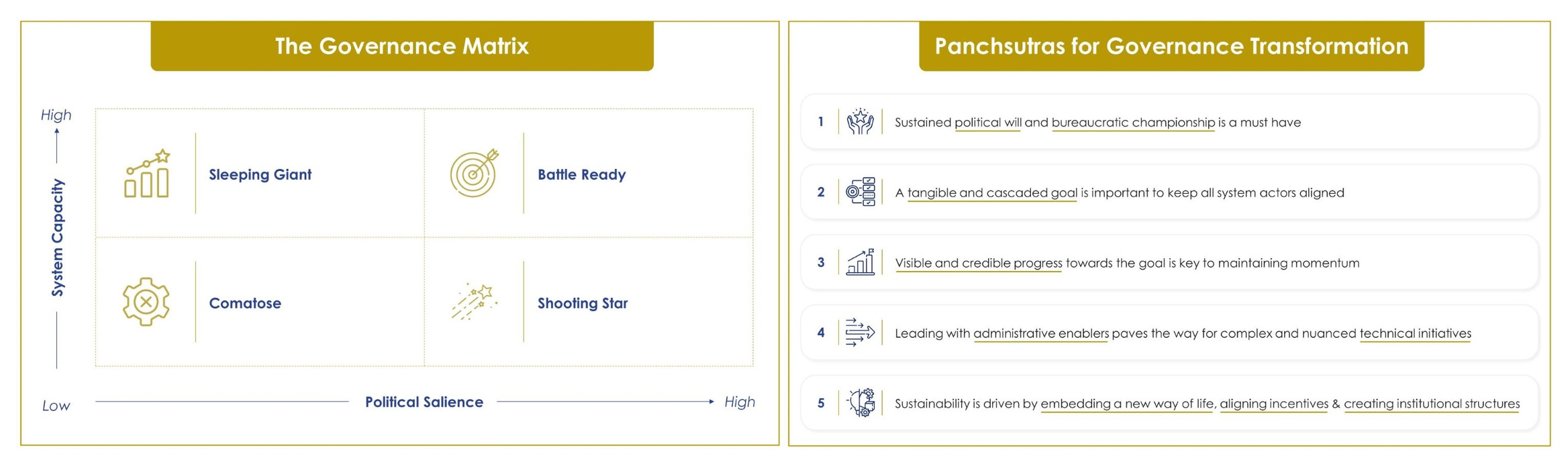
Given there was abundant political will, the goal was to optimise effort and time. Inertia and culture remained the most difficult challenges. The challenge is majestic because it requires pulling a comatose system into a shooting star system and then pushing for capacity reform till it progresses on capacity. The Jury is out on whether these reforms were as successful as they had claimed to be. But, they remain the most multi-pronged and committed reforms that have been carried out yet in Indian Schooling. They also remain a crucial roadmap for reforms focusing on the frontline bureaucracy. Yamini and her team emphasize the importance of front-line workers and middle-level bureaucracy and capture those valuable lessons for. It remains to be seen if the institutional structures and culture shift sought to be created are sustained.
Theoretical Questions that survive
How do we repurpose a bureaucracy? Is there any virtue in employing legalism in development bureaucracies generally?
In democratic developmentalism, where public participation is poor, how do we ensure accountability while preserving decentralisation?
How does administrative law balance“constrained by the law and therefore against the grain of it” and “within the frame of law and allowed by discretion”? Is legalism an essentially conservative force because an activisty judicial review leads to risk aversion?
Is it theoretically possible to devise rules to allow leeway for developmentalism and regulation and decentralisation? How do we think about bureaucratic inertia for compliance with rules?
If there is an essentialist obsession with regulations and compliance, everyone will want decentralisation only up to their level. How to then politically decentralise with rules still existing?
Earlier today, Gulzar Natarajan recommended that we collect learning assesment data through longitudinal survey studies representative at the block level conducted by independent assessment agencies.
This has already been prescribed in some detail by Karthik Muralidharan in Chap IV of his book Accelerating Development, generally for all development outcomes and specifically for education in Chap. XI.
Such measurement of learning would be an excellent first step in diagnosing the problem, setting a new benchmark and signaling a clear shift of organisational culture away from curriculum to learning.
Thanks for reading!